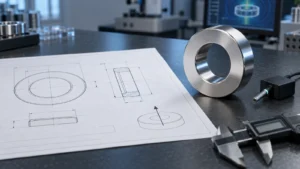
Samarium cobalt (SmCo) is often shortlisted when a neodymium magnet has too little temperature margin. The first question is not “What is the Curie temperature?” It is “What field or force must this part still deliver at the hottest point in the assembled device?” Those are different questions, and a single headline temperature cannot answer the second one.
Working temperature is grade and design dependent
SmCo is a family of materials, mainly 1:5 and 2:17 compositions. As a reference, Arnold’s published RECOMA grade table lists maximum operating temperatures from 250°C to 350°C for its listed grades. Adams Magnetic Products describes 350°C as a maximum for its standard 2:17 material, with special grades available for higher temperatures. These are supplier-specific ratings, not a blanket rating for every SmCo magnet or a Magnetstek product guarantee.
Some specialist materials may be designed for more severe service. Do not infer that an ordinary SmCo grade will operate continuously at 600°C. Ask for the exact material grade, its demagnetization curves at the intended temperature, and an agreed test in the actual magnetic circuit before setting a limit.
Curie temperature is not a usable operating limit
The Curie temperature describes where a material loses ferromagnetic order. Long before that point, useful output can fall, and a magnet may suffer irreversible loss if its working point crosses the knee of a hot demagnetization curve. A 750°C or 825°C Curie figure therefore does not mean the finished magnet can work at that temperature. Geometry, air gap, surrounding steel, opposing fields, and time at temperature all matter.
What changes when the magnet gets hot?
- Reversible output change: magnetic flux normally decreases as temperature rises and may recover on cooling. Specify the acceptable field or force at the operating temperature, not only at room temperature.
- Irreversible demagnetization: heat and opposing fields can permanently reduce output. Check the hot demagnetization curve against the part’s load line.
- Mechanical and environmental limits: sintered SmCo is brittle. Thermal cycling, mounting stress, impact, corrosion exposure and any coating or adhesive can limit the assembled design.
SmCo 1:5 or 2:17?
The composition is a starting point, not a temperature certificate. The required field at the working gap, part size, magnetization direction and maximum temperature determine which grade is worth evaluating. Compare supplier curves and available part geometries before choosing between 1:5, 2:17, a high-coercivity NdFeB grade, or another magnetic material. If the duty cycle includes a short heat excursion, state its duration separately from the continuous operating temperature.
A useful high-temperature SmCo RFQ
Send the drawing and identify the maximum continuous temperature, any short excursions, cycle count, cooling conditions, working gap and the minimum field or force needed there. Include external demagnetizing fields, assembly materials, coating or corrosion conditions, annual quantity and the measurement method you will accept. If you have a current magnet, provide its grade and measured performance at both room and operating temperature.
We can discuss the specification on the custom SmCo magnets page or through the inquiry form. Grade availability, achievable dimensions, inspection scope, price and lead time are confirmed for the particular drawing and quantity.
Questions buyers often ask
Can I specify SmCo simply as “600°C rated”?
No. A temperature rating needs an identified grade and test conditions. The published standard-grade tables linked above do not establish a universal 600°C continuous operating rating.
Does a high Curie temperature prove that my assembly will work?
No. Curie temperature is a material property; usable magnetic output depends on the grade and the completed magnetic circuit. Test the field or force at the required operating temperature.
What should be agreed before production?
Agree the drawing, material grade, magnetization direction, hot performance target, measurement location and temperature cycle. A room-temperature surface-gauss reading alone cannot establish high-temperature performance.