- Custom Magnets
- Standard Magnets
- Mounting Magnets
- Magnetic Assemblies
- About Us
- Knowledge


Menu
Custom SmCo parts · Drawing review
Specify the part for its working temperature and magnetic circuit
Send your drawing for a review of a custom samarium cobalt magnet. Choose between the Sm1Co5 and Sm2Co17 material families using the proposed grade, finished geometry, pole direction and magnetic output required in your assembly.
SmCo is often considered for elevated-temperature applications and magnetic stability. The allowable conditions depend on the individual grade and design. Available specifications, minimum order quantity and lead time are confirmed with the quotation.
Start with a shape, then define the dimensions, pole faces and operating conditions on the drawing.
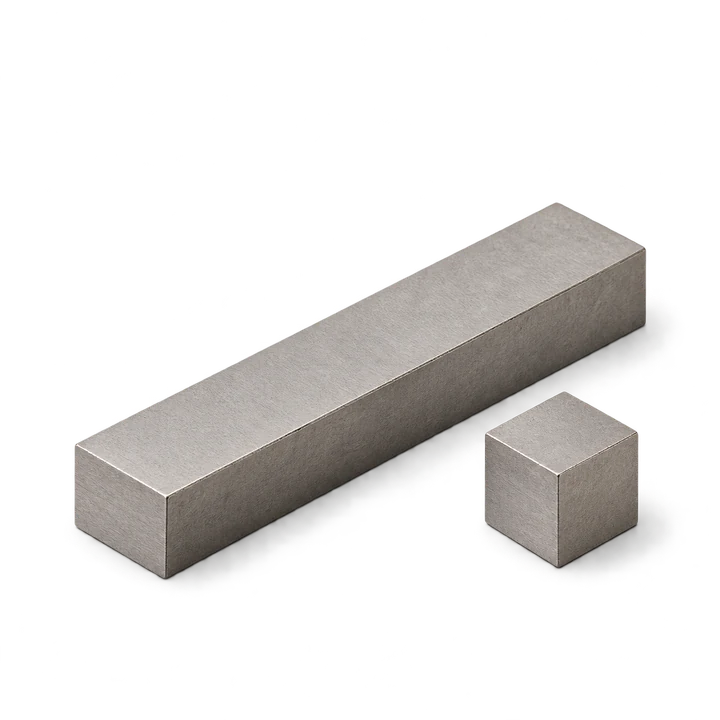
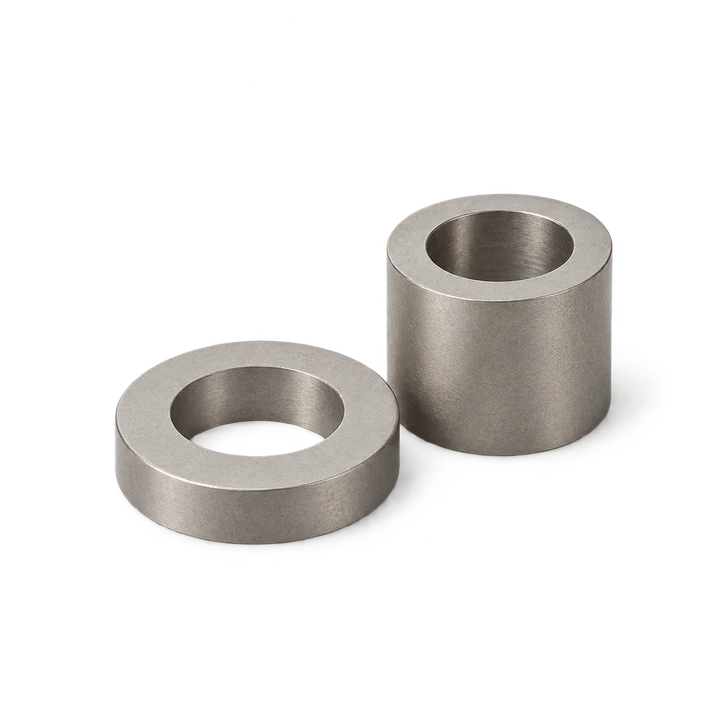
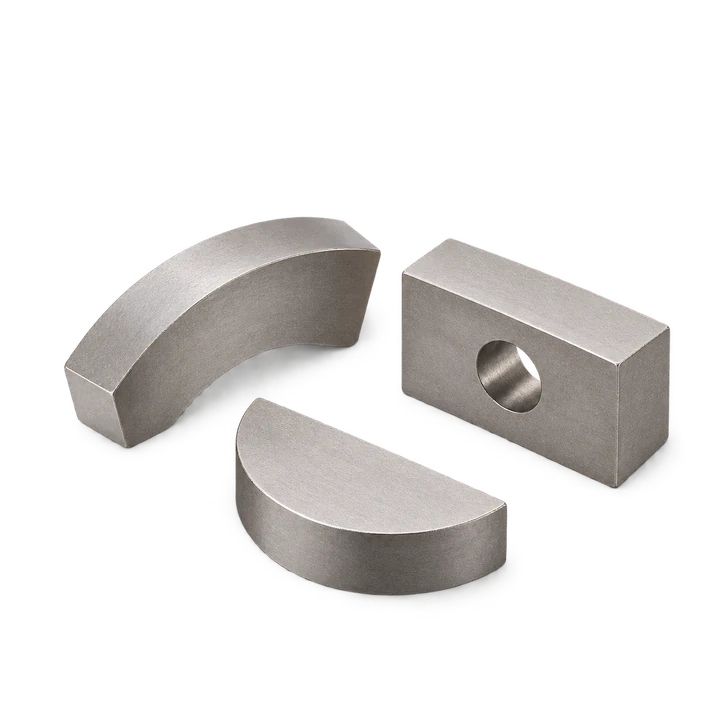
Shape images and technical diagrams are AI-generated concepts. Confirm the proposed part from its drawing and material documentation.
Material selection
The family name identifies the material system. It does not by itself specify the magnetic properties or a safe working temperature for the finished part. Review grade-specific data alongside the magnetic circuit and acceptance requirements.
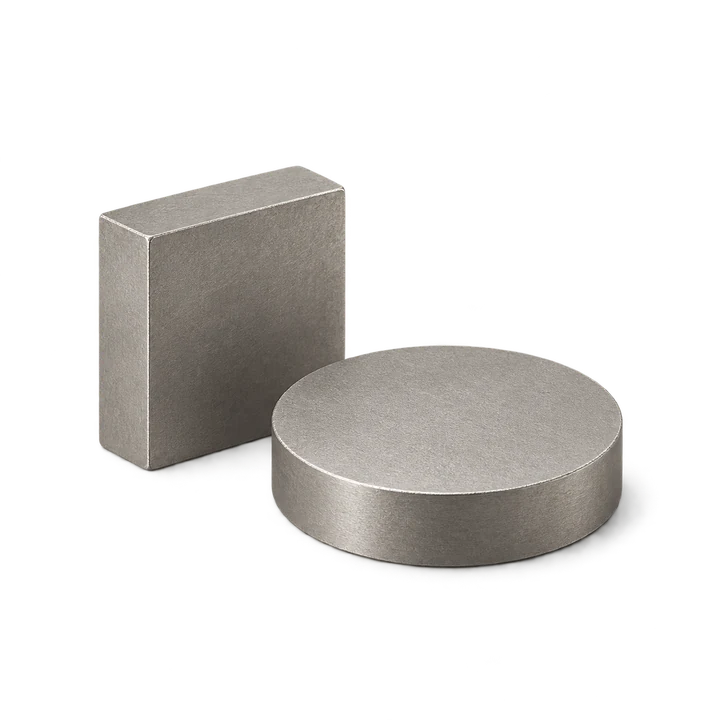
The 1:5 samarium-cobalt family is one starting point for a custom design. Confirm the proposed grade, geometry and magnetization requirements before comparing it with a 2:17 alternative.
Ask for the material data and temperature-dependent curves relevant to the proposed part rather than treating a general family value as an order specification.
Review Sm1Co5 selection details →
The 2:17 material family offers another set of grade options. Compare the required flux, resistance to demagnetization and thermal behavior for the actual working point.
Include opposing fields, the return path and the full temperature cycle in the review. The family label alone does not establish which grade will work in an assembly.
Review Sm2Co17 selection details →Shape concepts illustrate geometry; the material family is confirmed by documentation.
For a broader comparison, use the SmCo grade selection guide or compare SmCo and NdFeB against the same application requirements.
What to specify
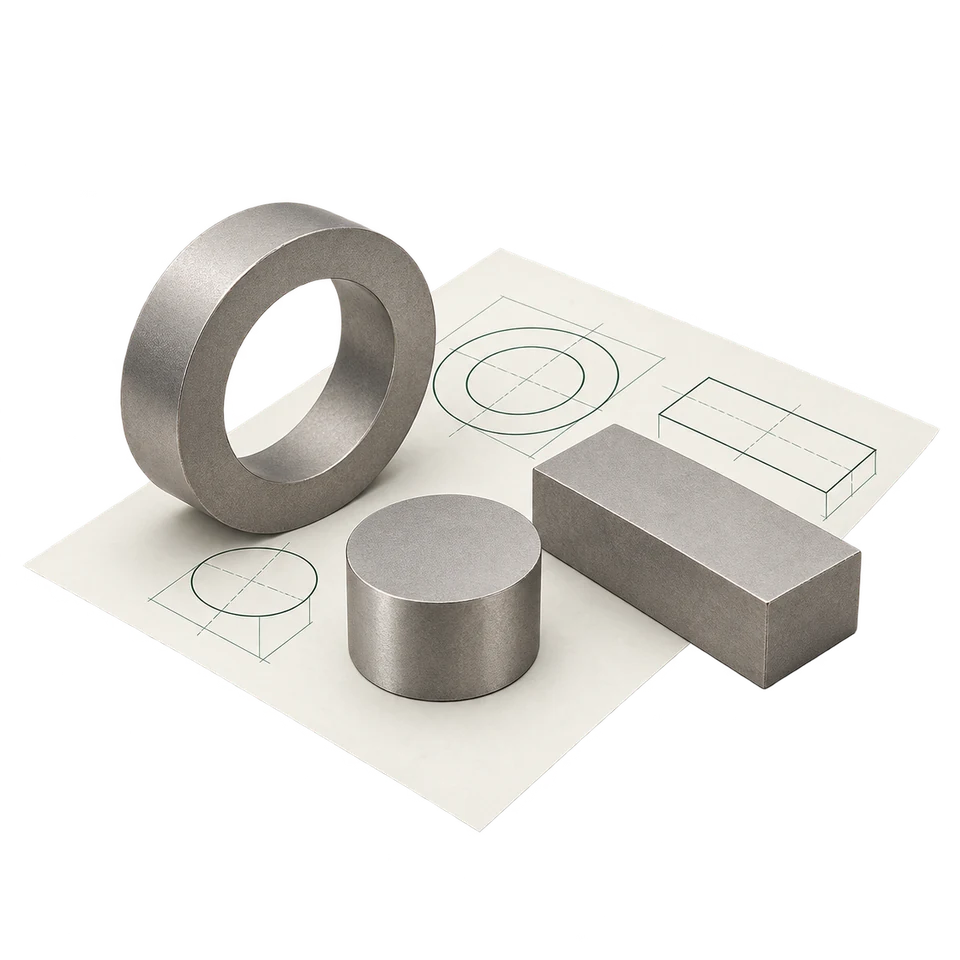
Provide dimensions, tolerances, holes, chamfers and mating surfaces. Identify critical dimensions and whether they apply after any coating.
State the requested grade or the field, flux or force needed in the assembly. Mark the measurement location, fixture and allowed range.
Mark pole faces, the magnetization axis or the pole pattern. A ring or arc shape alone leaves the pole arrangement open.
Include continuous and peak temperature, duration, cycling, working gap, return path and any opposing magnetic field.
Describe humidity, chemicals, cleaning, contact wear, adhesive and housing. Confirm any coating and dimensional allowance.
Give sample and production quantities, the inspection plan and required records. Confirm availability and delivery terms with the quote.
Engineering review
A catalogue temperature limit needs the grade, geometry and working point before it can guide a part specification. Irreversible magnetic loss can occur below the Curie temperature.
Review the proposed grade’s demagnetization curves at the relevant temperatures together with reverse fields and the assembly materials.
Use the SmCo temperature review guide →SmCo is a hard, brittle material. Review thin sections, holes, sharp edges and the assembly method from the drawing. Do not assume that a nominal material property establishes finished-part strength or holding force.
Agree the dimensions, polarity, surface condition and magnetic test arrangement that will be used for acceptance.
Prepare the first article checks →Technical reference
Open the topics relevant to your drawing. Numerical properties and allowable conditions must come from the agreed material and finished-part documentation.
Remanence (Br), coercive force (HcB), intrinsic coercivity (HcJ) and maximum energy product ((BH)max) describe different magnetic properties. Compare values with their units, temperature and test conditions. A family name or energy-product label is not a complete material specification.
Confirm the material designation, required limits and the records that apply to the proposed order. Reference data from another producer provides technical context; it does not establish the specification of a Magnetstek part.
Geometry, the magnetic circuit, the working point and opposing fields influence whether the part stays in a suitable region of its demagnetization curve. Evaluate continuous operation, brief peaks and cycling separately.
A reversible temperature coefficient describes an approximate change over a stated range. It does not predict irreversible loss or replace the grade’s temperature-dependent curves. Curie temperature is different from the allowable operating temperature.
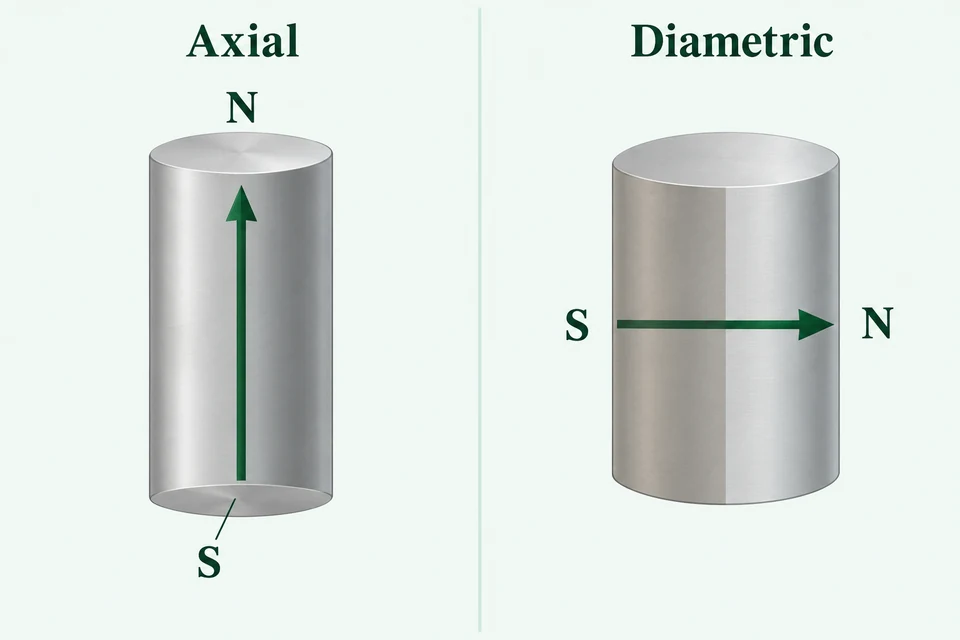
Show the required north and south pole faces, axis or pole pattern on the drawing. Axial, diametric and multipole arrangements have different geometry and fixture requirements. For a ring or arc, include where the useful field is needed in the assembly.
Specify the polarity or field check for acceptance, including the measurement location and working gap. Confirm feasibility for the finished dimensions before quotation.
Define the finished dimensions, tolerances, holes, chamfers and surfaces that locate the part. Thin walls, sharp corners and small features require a drawing review because SmCo is brittle.
Discuss handling, assembly loads and any protective housing. State which dimensions are critical and allow room for a proposed coating where it affects fit. Requested geometry and tolerances remain subject to feasibility review.
Decide from the proposed grade, environment, cleanliness requirements and mating materials. The coating decision should account for humidity, chemicals, cleaning, handling wear and exposed surfaces rather than a blanket corrosion claim.
If a coating is required, specify its material, thickness, coverage, dimensional allowance and inspection method. Medical, aerospace or other regulated uses require the relevant application-level validation; a material choice or coating alone does not establish qualification.
Density, thermal expansion, mechanical behavior and surface condition may matter alongside magnetic properties. Use data for the proposed material and temperature range when reviewing mass, fit, adhesives or a housing.
Do not use a generic physical-property table as a finished-part acceptance record. Agree the evidence needed for each design requirement.
For a motor, sensor, coupling, holding assembly or other design, identify the magnetic function and operating gap first. Include the return path, motion, thermal cycle, reverse field and environment.
Specify the required output and how it will be measured in the assembly. A general application example is a design starting point and does not establish that a particular SmCo grade or Magnetstek part is qualified for that use.
SmCo magnets can chip or fracture on impact. Plan separation, protective packaging, assembly tools and inspection for damaged edges. Keep loose magnets away from children and review pinch, fragment and magnetic-field hazards in the actual workplace.
For implanted medical devices or sensitive equipment, follow the device manufacturer’s instructions and the applicable site safety procedure. The component page is not a system safety assessment.
Parts & assemblies
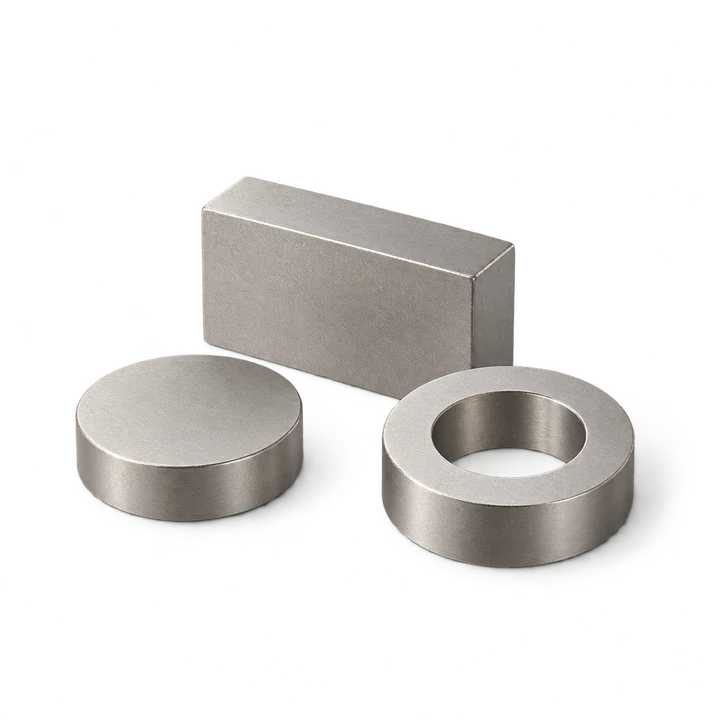
A custom shape is only one part of the specification. For an assembly, show the steel return path, adhesive or mechanical retention, mating gap and orientation.
The existing product video provides shape context. Confirm the particular material, dimensions and acceptance criteria for your drawing through the quotation.
From drawing to quotation
Step 1
Provide the drawing, quantity, magnetic function and operating conditions. Mark items that can still be discussed.
Step 2
Discuss grade, geometry, magnetization, surface and the assembly’s thermal and magnetic conditions.
Step 3
Confirm the drawing revision, test arrangement, acceptance limits and required documentation.
Step 4
Check available specifications, quantity, delivery and commercial terms before placing an order.
Documents & sources
If the review needs a material datasheet, temperature-dependent demagnetization curves, coating report or inspection record, list those documents in the inquiry. Confirm which apply to the proposed part and which can be supplied for the order.
For existing certification information, read the ISO 9001 certificate scope. It should be read within its stated scope.
Prepare the geometry, poles and working conditions for review.
RFQ guide →Compare the material families and questions to confirm for a grade.
Grade guide →Connect temperature limits to geometry and the magnetic circuit.
Temperature guide →Assess SmCo and NdFeB against the same design conditions.
Comparison guide →Technical context: Arnold’s grade-specific SmCo reference, Dura Magnetics’ temperature and working-point explanation and Adams Magnetic Products’ material catalogue. These references explain material behavior; their product specifications and qualifications are not Magnetstek supply claims.