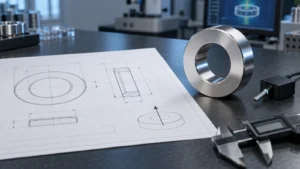
Project Background
A customer developing a miniature precision assembly required a very small NdFeB ring magnet with a center hole and controlled dimensions. The part was not a standard catalog magnet. It had to fit into a compact mechanism where available space was extremely limited, and the customer preferred a high-performance NdFeB grade such as N48 or N54.
At first glance, the magnet looked simple: a small ring-shaped permanent magnet. However, the engineering review showed that this was a high-precision micro magnet project. The small outer diameter, small center hole, short length, magnetic grade preference, coating requirement, and magnetization direction all had to be evaluated together.
For micro magnets, the main challenge is not only magnetic strength. The part must also be manufacturable, measurable, magnetizable, coat-able, and safe to handle during assembly. A high magnetic grade may appear attractive on paper, but if the geometry is too small or fragile, the final solution must balance magnetic output with machining feasibility and production consistency.
Magnetstek reviewed the customer’s drawing and application requirements to determine a practical manufacturing route for the custom micro NdFeB ring magnets.
Customer Requirement
The customer required a miniature ring or tube-style NdFeB magnet for use in a compact precision assembly. The magnet had to be produced according to drawing dimensions, with a small center hole and a clearly defined magnetic orientation.
| Item | Requirement |
|---|---|
| Material | NdFeB |
| Shape | Micro ring / tube magnet |
| Grade Preference | N48 or N54 |
| Outer Diameter | According to drawing |
| Inner Diameter | Small center hole |
| Length / Height | According to drawing |
| Magnetization | As marked on drawing |
| Coating | Subject to review |
| Application | Miniature precision assembly |
| Production Type | Prototype review and possible batch production |
The customer’s main concern was achieving a compact magnet with sufficient magnetic performance while maintaining dimensional accuracy. Because the magnet was very small, Magnetstek also reviewed whether the preferred grade and geometry could be produced reliably.
Why This Magnet Was Difficult to Manufacture
Micro NdFeB ring magnets are significantly more difficult to manufacture than standard disc, block, or cylinder magnets. When the dimensions become very small, every design feature becomes more sensitive.
1. Extremely Small Geometry
A micro magnet is not simply a smaller version of a standard magnet. NdFeB is a hard and brittle material, and very small parts are more vulnerable to chipping, cracking, edge damage, and handling loss.
For miniature ring magnets, the usable material volume is limited. Any machining stress, coating buildup, or handling impact can affect the final part. This makes the manufacturing route more demanding than for larger ring magnets.
2. Small Center Hole
The center hole was one of the most important features of the design. A small hole in a micro magnet creates several challenges:
- The wall thickness becomes limited.
- The hole must remain open after coating.
- Dimensional inspection becomes more difficult.
- Cleaning after machining and coating must be controlled.
- Handling damage around the hole edge must be avoided.
For micro ring magnets, the inner diameter can be more difficult to control than the outer diameter. If the hole is too small after coating, the magnet may not fit the customer’s shaft, pin, or internal feature. If the hole is too large, the part may lose alignment or magnetic performance.
3. N48 vs N54 Grade Selection
The customer preferred N48 or N54 grade. Both are high-performance NdFeB grades, but the highest grade is not always the best choice for a miniature magnet.
N54 can provide higher magnetic output in the same volume, but it may also introduce practical concerns, such as:
- More limited availability
- Higher cost
- Greater production sensitivity
- More difficult processing in very small geometry
- More careful magnetization review
N48 can often provide a better balance between magnetic strength, manufacturability, cost, and production stability. For micro magnets, choosing a slightly lower but more practical grade may result in better overall project success.
Magnetstek reviewed both options and considered whether the magnetic performance target could be achieved without creating unnecessary manufacturing risk.
4. Magnetization Direction
The drawing indicated a required magnetic orientation. For miniature magnets, magnetization direction must be confirmed before production.
A ring magnet can have different possible magnetization directions, including:
- Axial magnetization
- Diametrical magnetization
- Radial magnetization
- Multi-pole magnetization, depending on geometry and tooling
If the magnetization direction is incorrect, the part may fail in the final assembly even if the size and grade are correct. This is especially important in precision mechanisms, sensors, encoders, and miniature rotating components.
For this project, Magnetstek reviewed the pole orientation shown on the drawing and checked whether the requested magnetization was feasible for the selected size and grade.
5. Coating Thickness and Assembly Fit
NdFeB magnets usually require surface protection because the material is sensitive to corrosion. Common coatings include Ni-Cu-Ni, epoxy, zinc, gold, and Parylene, depending on the application.
For standard-size magnets, coating thickness is often a minor dimensional factor. For micro magnets, it can become critical. Coating thickness affects:
- Outer diameter
- Inner diameter
- Hole clearance
- Edge geometry
- Assembly fit
- Surface smoothness
If the coating is too thick or uneven, the center hole may become too small. If the coating is not suitable, corrosion resistance or bonding compatibility may be insufficient. For this reason, Magnetstek reviewed the coating requirement together with the final dimensional tolerance.
Magnetstek’s Engineering Review
Before quoting or starting production, Magnetstek performed an engineering review of the custom micro ring magnet design.
The review focused on the following points:
- Whether the OD, ID, and length could be manufactured reliably
- Whether the preferred N48 or N54 grade was suitable
- Whether an alternative grade should be considered
- Whether the center hole could be controlled after coating
- Whether the magnetization direction was feasible
- Whether the coating would affect assembly fit
- Whether tolerance requirements were practical
- Whether the part required special handling or packaging
- Whether inspection could confirm the required dimensions and polarity
This early review helped reduce production risk. Instead of treating the part as a simple small magnet, Magnetstek evaluated the complete manufacturing path from material selection to final packaging.
Manufacturing Approach
The manufacturing approach for custom micro NdFeB ring magnets must be carefully controlled. A general production route includes material preparation, precision machining, coating, magnetization, inspection, and protective packaging.
1. Material Selection
The first step was to evaluate the NdFeB grade. Because the customer preferred N48 or N54, Magnetstek considered both magnetic performance and manufacturability.
If the application requires maximum magnetic field in a limited space, N54 may be considered. If production stability, lead time, and machining feasibility are more important, N48 may be the better choice. In some projects, a high-temperature version or an alternative grade may also be recommended depending on the working environment.
2. Blank Preparation
Micro magnets are usually not produced directly in final shape from the beginning. A suitable magnet blank is prepared and then processed into the final geometry. The blank must be selected with enough material allowance for precision grinding while minimizing unnecessary waste.
3. Precision Grinding
NdFeB cannot be machined like ordinary metals. It is hard and brittle, so controlled grinding is required. For micro ring magnets, grinding must maintain the outer diameter, inner diameter, length, roundness, and edge condition.
The small size of the part increases the risk of chipping and breakage. Tooling, holding method, and process control are therefore important.
4. Center Hole Control
The center hole was a key feature of the design. Magnetstek reviewed how the hole dimension would be maintained through machining and coating.
For micro ring magnets, the center hole may need special attention during:
- Machining
- Cleaning
- Surface treatment
- Coating
- Final inspection
The goal is to ensure that the final inner diameter remains within the usable range after all processing steps.
5. Edge Protection
Small edges and corners are vulnerable to chips. If the drawing includes chamfer or edge requirements, these should be reviewed carefully. In some cases, a small controlled edge break may improve handling reliability without affecting assembly.
6. Coating Review
The coating was reviewed according to corrosion protection, thickness control, and assembly fit. For very small magnets, coating must be selected not only for environmental resistance but also for dimensional control.
If the application involves humidity, chemicals, or special cleanliness requirements, additional coating review may be needed.
7. Magnetization
After machining and surface treatment, the magnets are magnetized according to the specified direction. For micro magnets, magnetization fixtures and magnetic field strength must be suitable for the small geometry and grade.
The pole direction should be verified after magnetization, especially when the customer’s drawing shows a specific N/S orientation.
8. Protective Packaging
Micro magnets are easy to lose and can chip if allowed to attract each other suddenly. Magnetized micro parts also tend to stick to tools, trays, and each other. Proper packaging is therefore essential.
For this project type, Magnetstek recommends separated packaging, clear labeling, and protection against impact during transport.
Inspection and Quality Control
Inspection is especially important for micro magnets because small deviations can affect final assembly performance.
The inspection plan may include:
- Outer diameter measurement
- Inner diameter measurement
- Length / height measurement
- Visual inspection under magnification
- Coating appearance check
- Hole clearance confirmation
- Magnetization direction verification
- Polarity confirmation
- Surface field or flux check if required
- Packaging and labeling inspection
For miniature parts, standard visual inspection may not be enough. Magnification can help detect chips, cracks, blocked holes, or coating defects. If the magnet is used in a sensor or precision device, magnetic field consistency may also be more important than pull force.
Result
After reviewing the drawing, Magnetstek confirmed that the project required a balanced approach rather than simply selecting the strongest grade.
The key result was a manufacturable micro NdFeB ring magnet solution that considered:
- Required compact geometry
- Small center hole control
- N48 / N54 grade feasibility
- Coating effect on final dimensions
- Magnetization direction
- Dimensional inspection
- Protective packaging
The project demonstrated an important point for custom micro magnet sourcing: magnetic grade alone does not define success. A micro magnet must be designed and manufactured as a complete engineering component.
By reviewing the drawing early, Magnetstek helped reduce the risk of quoting an unrealistic specification or producing a part that would not fit the final assembly.
Procurement Guide: How to Specify Micro NdFeB Ring Magnets
To receive an accurate quotation for custom micro NdFeB ring magnets, buyers should provide as much technical information as possible.
| RFQ Item | Recommended Information |
|---|---|
| Material | NdFeB |
| Shape | Ring magnet / tube magnet |
| Outer Diameter | Required OD and tolerance |
| Inner Diameter | Required ID and tolerance |
| Length / Height | Required length and tolerance |
| Grade | N48, N54, or acceptable alternatives |
| Magnetization | Axial, diametrical, radial, or drawing-marked |
| Coating | Ni-Cu-Ni, epoxy, Parylene, gold, or supplier recommendation |
| Working Temperature | Continuous and peak temperature |
| Application | Sensor, precision assembly, miniature mechanism, etc. |
| Quantity | Prototype and production quantities |
| Inspection | Dimensional report, magnetic test, polarity check |
| Drawing | Strongly recommended |
A good RFQ may look like this:
Product: Custom micro NdFeB ring magnet
Material: NdFeB
Grade: N48 or N54 preferred; alternative grade acceptable after review
Dimensions: According to drawing
Magnetization: As marked on drawing
Coating: Supplier recommendation, final dimensions must remain within assembly requirement
Quantity: Prototype samples first, batch production after approval
Application: Miniature precision assembly
This type of RFQ helps the supplier review feasibility quickly and recommend a practical manufacturing route.
FAQ
What are micro NdFeB ring magnets used for?
Micro NdFeB ring magnets are used in miniature sensors, precision mechanisms, compact actuators, magnetic couplings, small rotating parts, positioning systems, and specialized assemblies where strong magnetic performance is needed in a very small space.
Why are micro ring magnets difficult to manufacture?
They are difficult because NdFeB is hard and brittle, and the small size leaves very little room for machining error. Small center holes, thin walls, tight tolerances, coating thickness, and handling damage all increase production difficulty.
Can N54 be used for very small NdFeB ring magnets?
N54 may be possible in some micro magnet designs, but feasibility depends on size, shape, tolerance, magnetization direction, and production route. In some cases, N48 may be a more practical option.
Is N48 better than N54 for miniature magnets?
N54 is usually stronger, but N48 may offer better manufacturability, availability, cost control, and production stability. The best grade depends on the actual magnetic requirement and geometry.
How does coating affect small center holes?
Coating adds thickness to the magnet surface, including the inner hole. For micro ring magnets, this can reduce hole clearance and affect assembly fit. Coating thickness should be considered during design.
Can micro ring magnets be axially or diametrically magnetized?
Some micro ring magnets can be axially or diametrically magnetized, but feasibility depends on geometry, grade, and magnetization tooling. The required direction should be clearly marked on the drawing.
What tolerances are possible for micro magnets?
Tolerance capability depends on magnet size, shape, material grade, coating, and inspection method. Buyers should identify which dimensions are truly critical instead of applying unnecessary tight tolerances to all features.
Do micro magnets require special packaging?
Yes. Micro magnets are small, brittle, and easy to lose. Magnetized parts can also attract each other and chip. Separate packaging and clear labeling are recommended.
Should pull force be specified for micro magnets?
It depends on the application. For holding applications, pull force may be useful. For sensors, encoders, and precision assemblies, surface field, flux density, or field direction may be more important.
What information is needed for quotation?
A drawing, material, grade preference, OD, ID, length, tolerance, coating, magnetization direction, quantity, working temperature, and application details are recommended.
Conclusion
This case study shows why custom micro NdFeB ring magnets require careful engineering review before production. A small magnet with a center hole may look simple, but the actual manufacturing process involves grade selection, micro-hole control, coating review, magnetization feasibility, dimensional inspection, and protective packaging.
For miniature precision assemblies, choosing between N48 and N54 is only one part of the decision. The final magnet must fit the mechanical design, provide the required magnetic performance, maintain dimensional accuracy after coating, and survive handling and assembly.
Magnetstek supports custom micro NdFeB ring magnets, disc magnets, cylinder magnets, block magnets, and magnetic assemblies. Send us your drawing, grade preference, magnetization direction, coating requirement, and quantity, and our team can help evaluate a practical micro magnet solution for your project.