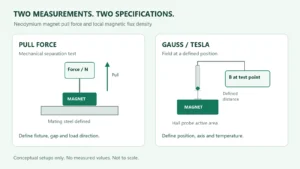
N52 is a grade designation for sintered neodymium-iron-boron (NdFeB) magnets. The number refers to the material’s approximate maximum energy product in megagauss-oersteds (MGOe). It does not mean a magnet will pull 52 pounds, nor does it specify the field at your sensor or the holding force in your assembly. For a custom part, geometry and working conditions matter as much as the grade.
What does N52 tell you?
Maximum energy product, written (BH)max, describes the energy density available from a magnetic material. An N52 grade typically has a higher (BH)max than an N42 grade from the same product family. Supplier datasheets still give ranges rather than one exact value: for example, Arnold Magnetic Technologies lists its N52 material with a 49–53 MGOe range. Use the actual grade datasheet when setting acceptance limits, especially if you compare offers from different producers.
The grade alone does not define remanence (Br), intrinsic coercivity (Hcj), dimensional tolerance, coating, or magnetization direction. Those details belong on the drawing or purchase specification. See our NdFeB grade overview for the broader material choices.
Will N52 give more pull force than N42?
Possibly, if the two magnets have identical dimensions, magnetization, coating, test fixture, and air gap. There is no fixed percentage increase that applies to every design. A small gap, a thin steel mating part, or a change in magnet thickness can move the result more than a grade change. The useful comparison is the force or field measured at the working position, not a grade number in isolation.
For a sensor, specify the field range and polarity at the installed sensor location. For a holding magnet, specify the mating material, contact area, coating and test gap. If you are designing a sensor assembly, our working-gap guide explains why a surface-gauss reading is insufficient.
Temperature and demagnetization
A catalog maximum operating temperature is a screening value, not a guarantee for every N52 shape. Thin magnets and magnets exposed to a strong opposing field can lose performance at temperatures that a larger part tolerates. The temperature inside a motor or enclosed assembly may also exceed ambient temperature. Ask for the grade’s demagnetization curves and check the worst-case operating point with the actual geometry.
High-coercivity variants use suffixes such as H or SH, but suffix meanings and available grades should be checked against the selected producer’s datasheet. Do not assume that adding an H suffix makes a part suitable for a particular temperature. If heat is a design driver, compare the required field at temperature, coercivity, geometry and cost; SmCo may also be worth evaluating.
Coating, corrosion and handling
NdFeB contains iron and generally needs appropriate surface protection where moisture or chemicals are present. Nickel and epoxy are common coating options, but the right choice depends on exposure, assembly method and dimensional allowance. Coating thickness changes the finished size and the working gap. Edges can chip, and a damaged coating can undermine corrosion protection. Define whether dimensions are measured before or after coating and identify the faces that must remain free of chips.
What to put in an N52 magnet RFQ
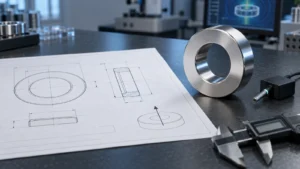
A drawing helps a supplier quote the same part you intend to test. Include the following before comparing price or lead-time proposals:
- Finished geometry: shape, dimensions, tolerances, edge details and any holes or slots.
- Magnetic requirement: N52 or an acceptable alternative, magnetization direction, pole orientation, and the field or force required at a stated test position.
- Environment: operating and peak temperatures, humidity, chemicals, and any opposing magnetic field.
- Surface: coating type, finished thickness allowance, critical cosmetic or chip limits, and any bonding surface.
- Verification: sample quantity, measurement method, acceptance criteria and the documents you need with the order.
For production approval, our first article inspection checklist covers dimensional, polarity, magnetic-output and coating checks.
When another grade may be better
N52 is useful when available space is tight and the design benefits from high energy density. It is not automatically the best economic or technical choice. A lower grade with more volume may meet the same working-gap target; a higher-coercivity grade may be more appropriate for heat or demagnetizing fields. Test the assembled part under the intended conditions before freezing the grade.
Questions buyers often ask
What if my drawing calls for N52H?
N52H denotes a higher-coercivity NdFeB grade, but the label alone does not confirm suitability at a specified temperature or current availability. Include the finished dimensions, magnetization direction, operating and peak temperatures, any opposing field, and the field or force required at the working gap. Request the proposed producer’s datasheet and temperature-dependent demagnetization curves for the actual geometry. As one supplier example, Shin-Etsu’s N52H-G datasheet includes temperature curves and notes that properties can vary with size and shape.
Does N52 mean 52 pounds of pull?
No. The number relates to a material property, (BH)max, expressed in MGOe. Pull force depends on magnet size, magnetization, the mating steel and the gap used in the test.
Is N52 always the strongest available magnet?
No. Available grades and specialty materials vary by producer. More importantly, the strongest material on a datasheet may not deliver the best field or durability in your assembly.
Can I specify only “N52” on a drawing?
That leaves critical requirements open. Add the finished dimensions, magnetization direction, coating, operating conditions and an agreed measurement method. If performance at a particular gap matters, put that target on the drawing too.
Discuss a custom NdFeB part
For shapes and specification details, see our custom neodymium (NdFeB) magnets page. Send Magnetstek your drawing and working conditions through the inquiry form. If the grade is still open, include the field or force you need at the actual working gap. We can review the specification and quote against a defined part rather than a grade label alone.
Technical references: Arnold Magnetic Technologies, NdFeB grade data and temperature guidance; Adams Magnetic Products, permanent magnet material selection. Supplier tables are examples; request the datasheet for the material proposed in your quotation.