Pull force and gauss measure different things. Learn which test to specify for a custom neodymium magnet and what to include with your drawing.
A practical first article inspection checklist for custom magnets: verify finished dimensions, polarity, magnetic output, coatings, and approval records before production.
Surface gauss is only the start. Specify a custom sensor magnet by the field at the IC, then approve it with a repeatable working-gap test.
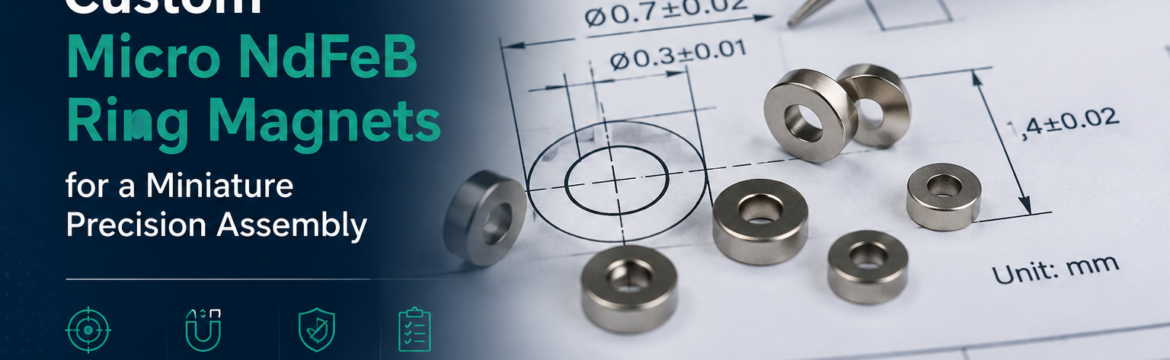
Design Scenario This guide uses an illustrative micro NdFeB ring magnet for a miniature precision assembly to show what a buyer should specify. It does not document a particular customer project or a completed production result. A small ring with a center hole needs a combined review of outer and inner diameter, wall thickness, length, […]
Compact medical pump designs may use a multi-pole radial magnet ring for a motor or magnetic coupling. Geometry, pole pattern, material, coating, and retention must be matched to the intended assembly. This article reviews engineering questions and verification steps relevant to such a component. Magnet performance alone does not establish finished-device safety or clinical suitability. […]
When precision is the name of the game, even the smallest miscalculation can lead to costly mistakes. For engineers and industries relying on Neodymium Magnets, thermal stability is a crucial factor. But what happens when these powerful magnets are exposed to fluctuating temperatures? That’s where the Coefficient of Thermal Expansion (CTE) becomes vital—helping you anticipate […]