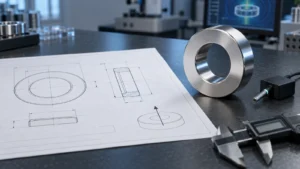
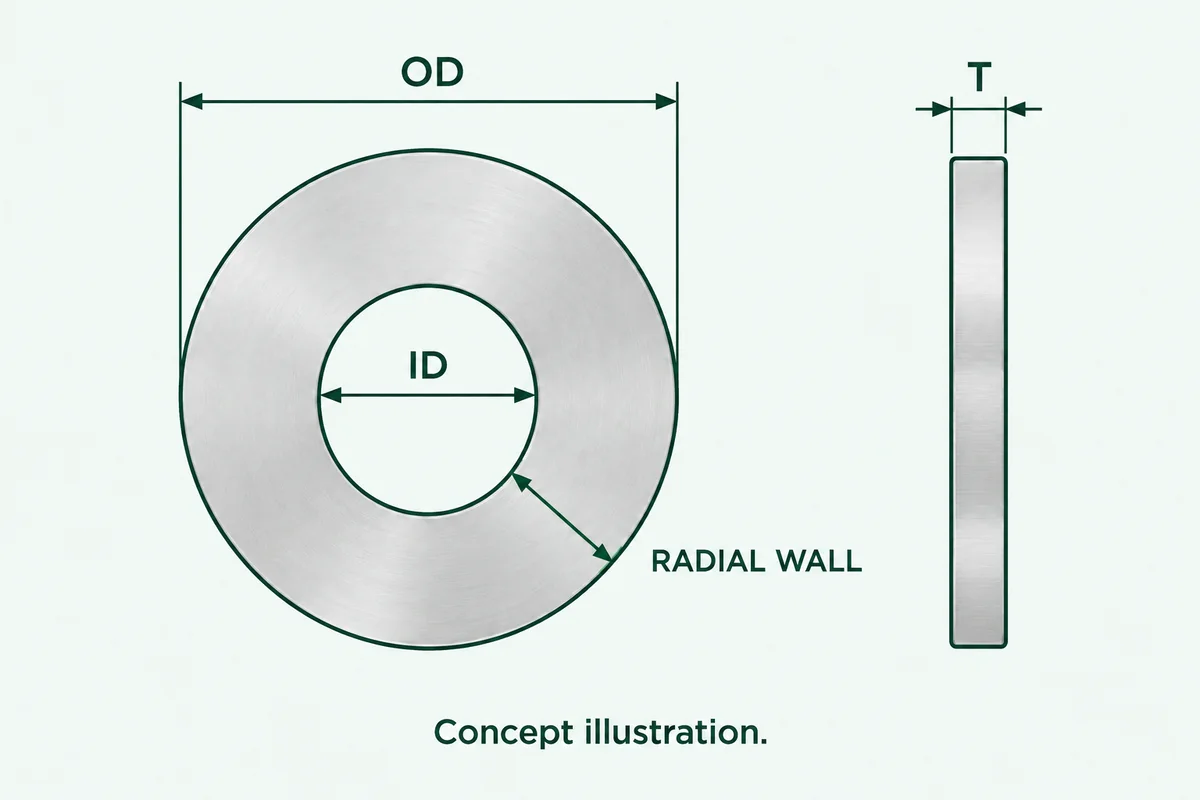
Ring magnets need three separate dimensions: outside diameter (OD), inside diameter (ID) and axial thickness (T). A request for a “thin ring” also needs to say whether thin refers to the axial thickness or the radial wall. Add the pole direction, finished tolerances and application conditions before asking for a quotation.
For neodymium ring magnets, start with the custom neodymium (NdFeB) magnets page. The checks here help turn a ring-shaped idea into a drawing that can be reviewed. Material, geometry, coating, magnetic output and availability remain subject to the specific quotation.
1. Give ring magnets three dimensions
Label OD, ID and T on the drawing, with the unit system stated. OD is the overall outside diameter; ID is the bore diameter. T runs between the two flat annular faces. The radial wall is the band of material between the bore and the outside surface. For a concentric circular ring, its nominal width is (OD − ID) / 2.
A description such as “outside diameter × width” leaves the bore diameter unresolved and the meaning of width open. It could mean axial thickness or radial wall width. Ask which surfaces the measurement spans and include a top view and side view. This is an example of wording to clarify, not a claim that either design can be supplied.
2. Define the finished fit
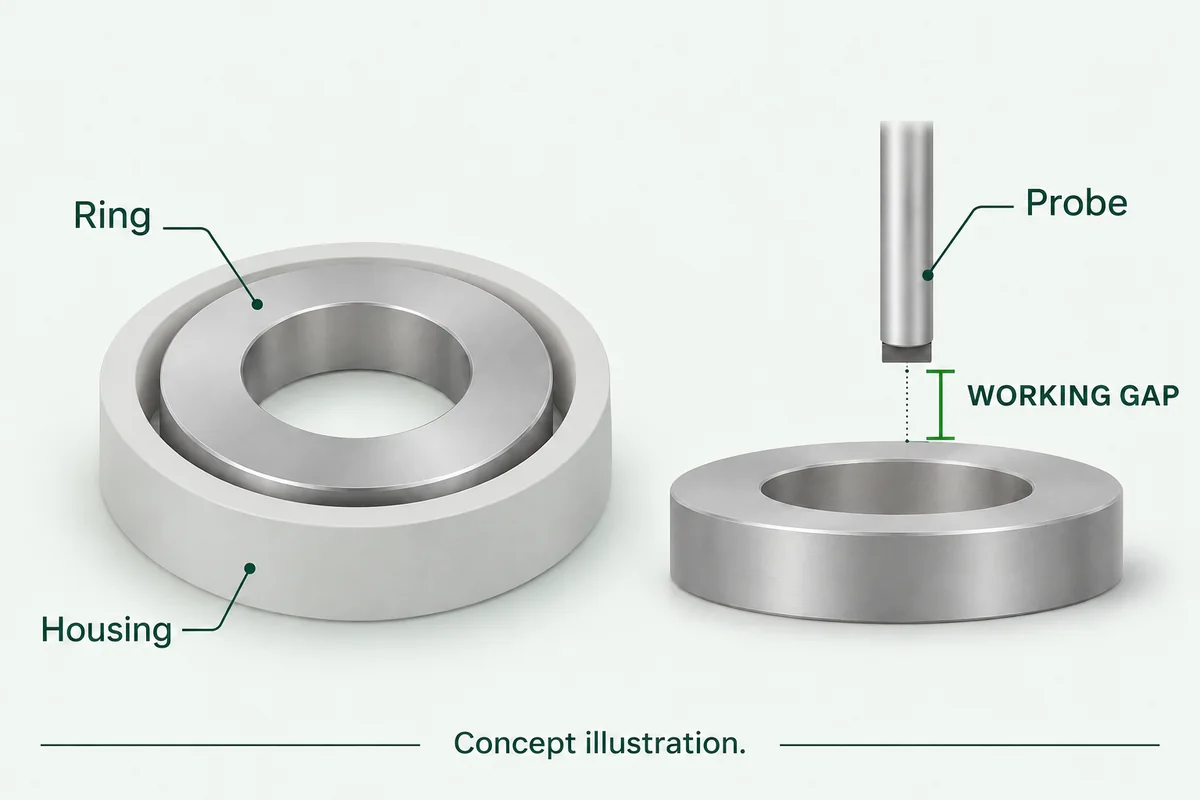
For coated ring magnets, state whether dimensions apply after coating. A bore that fits before plating may have different clearance after finishing. Identify the housing, shaft or mating feature and the assembly method. If the bore locates the part, discuss its size and relationship to the outside surface; if a flat face sets the working gap, identify that face on the drawing.
Use tolerances that follow the function. A general request for “high precision” leaves the acceptance limits unresolved. Agree how critical features will be measured, especially when a thin section could be damaged by handling or excessive measurement force. ASME Y14.5 provides a framework for communicating dimensional and geometric requirements. A reference to that standard does not establish a supplier’s achievable tolerances.
3. Draw the pole direction
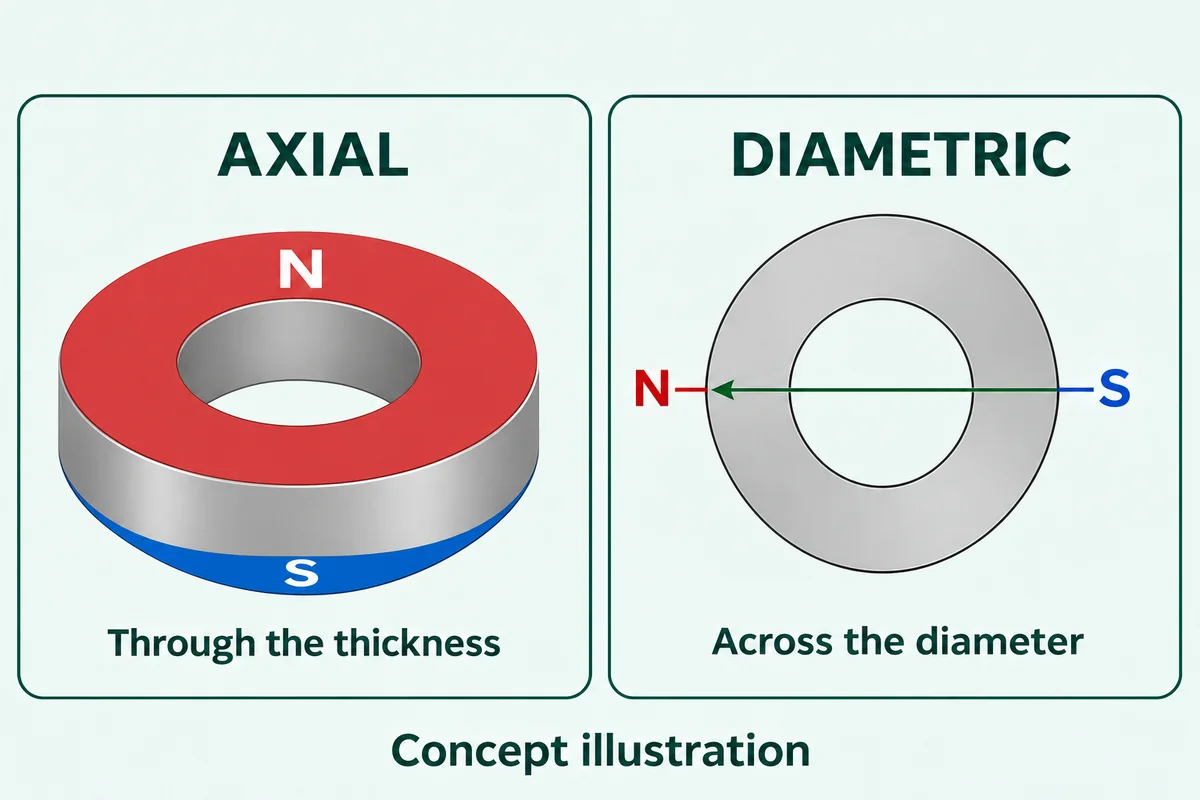
Ring shape alone does not define magnetization. Axial magnetization places the opposing poles on the flat faces. Diametric magnetization runs across the diameter. K&J’s magnetization direction guide illustrates both arrangements for rings.
Radial magnetization, with inner and outer curved surfaces acting as opposing pole regions, is a separate specification. A multipole pattern also needs its own pole map. Do not use “radial” as a synonym for “diametric.” For a sensor or encoder, provide the sensing position, required field component and angular relationship to any locating feature. Review the proposed material, geometry and magnetizing arrangement together before confirming feasibility.
4. Review material at the operating conditions
Select the material for ring magnets against the required magnetic function, temperature and environment. An NdFeB grade describes material properties; it does not by itself specify the field in a sensor gap or the holding force against steel. A higher grade number alone cannot settle a design that also changes the bore, thickness, nearby steel or magnetization direction.
Give continuous and peak temperatures, exposure duration, thermal cycling and any opposing magnetic field. Request applicable material data and temperature-dependent demagnetization curves for the proposed grade. The working point depends on the magnetic circuit. Arnold’s NdFeB material reference discusses grade selection, use temperature and corrosion. Its data describe Arnold materials and do not establish Magnetstek’s supplied specification.
5. Specify finish and assembly
Describe humidity, contact with liquids or chemicals, cleaning and handling. Review the coating system with the base material and the finished fit. A coating name alone does not define its thickness, coverage, resistance to a particular environment or inspection criterion. Use the NdFeB coating guide to prepare those questions.
Sintered NdFeB is brittle, a limitation also discussed in K&J’s ring magnet reference. Thin ring magnets need a handling and retention review; forcing one onto a shaft or tightening a screw against it can damage the part. Show how the ring is supported and retained, and identify adhesive or housing requirements. Avoid treating a plain bore as a countersunk fixing hole. Confirm any edge details and allowable chips on functional surfaces before approving samples.
6. Agree on the magnetic acceptance test
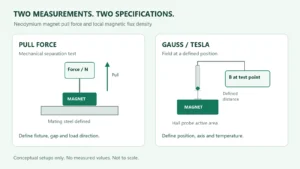
Choose a measurement that represents the function. For a sensing application, define the probe location, orientation, working gap, temperature and acceptance range. For holding, identify the mating steel, its dimensions and surface condition, the gap and the direction of separation. K&J’s pull-force test explanation shows why readings from different magnetic circuits are not interchangeable.
A surface-field value, material energy product and pull-force result answer different questions. Agree which one controls acceptance and record the fixture or method. Check polarity against a defined face or datum as well. Use the same method for sample approval and later deliveries, with the required sampling and records stated in the order.
7. Send a controlled RFQ package
Keep the part number and revision consistent across the drawing, model and inquiry. Separate fixed requirements from dimensions or materials that may be discussed. Include prototype and production quantities so the review covers the intended order rather than an unspecified sample.
| RFQ item | Information to include |
|---|---|
| Geometry | OD, ID, axial thickness, units, finished tolerances and edge details |
| Magnetization | Pole map, reference face or datum, required orientation |
| Application | Working gap, mating parts, temperature, environment and retention |
| Acceptance | Dimensional checks, polarity check, magnetic test setup and limits |
| Order scope | Drawing revision, quantities, required reports and packaging identification |
The custom magnet drawing guide covers a fuller specification. Before production, agree the sample approval and inspection records using the first article inspection checklist.
Have a ring drawing ready? Send it for a neodymium ring magnet review with the application, pole direction and quantity. Confirm the proposed specification, documentation, price and schedule in the quotation.
Common questions about ring magnets
Is “diameter × width” enough to quote a ring?
It leaves the bore or the meaning of width open. Specify OD × ID × axial thickness, with units and finished tolerances. A sketch should show which feature each dimension controls.
Does a hole make a ring radially magnetized?
No. The central hole describes geometry. Axial, diametric, radial and multipole arrangements describe different pole patterns and need an explicit drawing or specification.
Can a grade or catalogue pull force replace an application test?
A grade identifies material properties, while a catalogue pull force belongs to a particular test setup. Define the application’s gap, mating parts, temperature and acceptance method, then confirm the requirement on representative samples.
Technical references
- ASME Y14.5: Dimensioning and Tolerancing, drawing communication framework.
- K&J Magnetics: Magnetization Directions, axial and diametric examples.
- Arnold Magnetic Technologies: NdFeB materials, material selection and corrosion context.
- K&J Magnetics: How Much Will a Magnet Hold?, test configuration and holding-force context.