

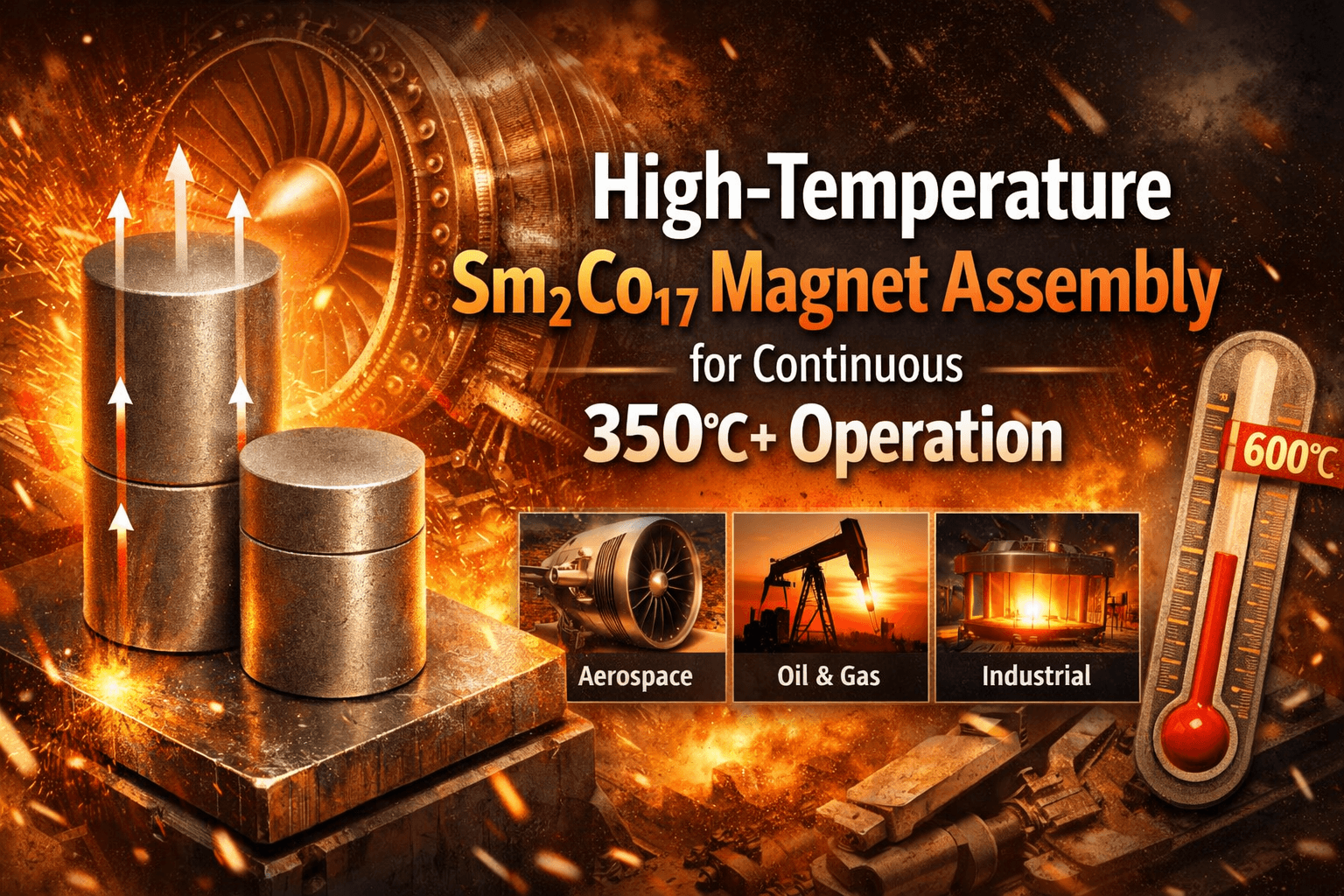
In modern industrial systems, few engineering challenges are as demanding as maintaining stable magnetic performance at continuous temperatures of 350°C and above. At these temperatures, most permanent magnet materials fail—either through irreversible demagnetization, rapid flux decay, oxidation, or structural degradation.
For such environments, Sm₂Co₁₇ (Samarium Cobalt 2:17 type) magnets represent one of the most reliable and proven solutions. This article provides a comprehensive overview of high-temperature Sm₂Co₁₇ magnet assemblies, including material science foundations, design considerations, dimensional strategies, magnetization challenges, thermal stability, corrosion behavior, and long-term reliability for continuous high-temperature applications.
1. Why High-Temperature Permanent Magnets Are Challenging
Permanent magnets are widely used in:
- Electric motors
- Sensors and encoders
- Actuators
- Turbine systems
- Oilfield tools
- Aerospace positioning systems
However, temperature dramatically affects magnetic materials. As temperature increases:
- Magnetic flux density (Br) decreases
- Coercivity (Hcj) reduces
- Risk of irreversible demagnetization increases
- Oxidation accelerates
- Mechanical strength decreases
For continuous exposure at 350°C or higher, common materials fail:
| Magnet Type | Typical Max Operating Temperature |
|---|---|
| NdFeB | 80–200°C (special grades up to 230°C) |
| AlNiCo | High temperature tolerant but very low coercivity |
| Ferrite | Good thermal stability but low magnetic strength |
| SmCo5 | ~250–350°C |
| Sm₂Co₁₇ | Up to 550–600°C |
Sm₂Co₁₇ stands apart as the only commercially practical permanent magnet material capable of sustained operation above 350°C while maintaining strong magnetic properties.
2. Understanding Sm₂Co₁₇ (2:17 Type) Material Structure
Samarium Cobalt magnets are divided into two main categories:
- SmCo5 (1:5 type)
- Sm₂Co₁₇ (2:17 type)
Sm₂Co₁₇ contains additional alloying elements such as:
- Iron (Fe)
- Copper (Cu)
- Zirconium (Zr)
These elements form a cellular microstructure that enhances coercivity and temperature stability.
Key Characteristics of Sm₂Co₁₇:
- Higher maximum energy product (17–35 MGOe)
- Superior intrinsic coercivity at elevated temperatures
- Lower reversible temperature coefficient
- Higher Curie temperature (~800°C)
- Improved resistance to thermal demagnetization
The 2:17 structure is specifically engineered for demanding thermal environments.
3. Typical High-Temperature Magnet Assembly Configuration
A common configuration for high-temperature systems includes:
- Round disk geometry
- Diameter around 25 mm
- Height between 25 mm and 50 mm
- Axial (through-length) magnetization
- Continuous operation ≥ 350°C
This configuration is frequently selected for:
- High-temperature motor rotors
- Magnetic couplings
- Turbine position sensing
- Downhole drilling motors
- Aerospace actuator systems
Stacking smaller magnets (e.g., 2 × 25 mm instead of 1 × 50 mm) is often preferred to reduce mechanical stress and improve magnetization reliability.
4. Thermal Stability at 350°C and Beyond
Continuous high-temperature operation introduces several critical engineering concerns.
4.1 Reversible vs Irreversible Flux Loss
At elevated temperatures:
- Reversible loss occurs due to intrinsic temperature coefficient
- Irreversible loss occurs if coercivity becomes insufficient
Sm₂Co₁₇ exhibits:
- Reversible temperature coefficient (Br): ~ -0.03% / °C
- Strong coercivity retention at 350°C
By selecting high-Hcj grades, irreversible demagnetization can be minimized even during long-term exposure.
4.2 Long-Term Aging Behavior
Over months of exposure at 350°C:
- Domain stability is critical
- Microstructural stability determines flux retention
- Alloy homogeneity becomes important
High-quality Sm₂Co₁₇ magnets show minimal long-term magnetic decay when properly engineered.
5. Mechanical Considerations in High-Temperature Assemblies
Sm₂Co₁₇ magnets are:
- Brittle ceramic-like materials
- High compressive strength
- Low tensile strength
- Sensitive to impact and thermal shock
5.1 Thermal Expansion Mismatch
Coefficient of thermal expansion (CTE):
- Sm₂Co₁₇ ≈ 10–12 ×10⁻⁶ /K
Housing materials (e.g., steel, titanium) must be selected carefully to avoid excessive stress.
Best practice:
- Install magnet under compressive preload
- Avoid tensile constraint
- Provide thermal expansion allowance
5.2 Cracking Risk in Tall Magnets
For 25 mm diameter × 50 mm height magnets:
- Increased internal stress during sintering
- Magnetization difficulty
- Higher cracking probability
Stacking two 25 mm height magnets often improves reliability and manufacturing yield.
6. Magnetization Strategy
Axial magnetization through height is common in disk magnets.
However, thicker magnets require:
- Higher magnetizing field strength
- Proper fixture design
- Adequate pulse magnetization energy
Incomplete magnetization may result in:
- Reduced surface flux
- Non-uniform magnetic field
- Performance degradation
Engineering verification via gaussmeter mapping is recommended.
7. Oxidation and Surface Protection
At 350°C in air:
- Surface oxidation occurs
- Cobalt oxidation may develop over time
- Mechanical surface degradation possible
Sm₂Co₁₇ has better oxidation resistance than NdFeB, but protection may still be required.
Options:
- Phosphate coating (thin, temperature resistant)
- High-temperature ceramic coatings
- No coating in inert atmosphere
Nickel plating is generally not suitable above 300°C for long-term exposure.
8. Performance Properties at Elevated Temperature
Typical room temperature properties:
| Property | Value |
|---|---|
| Br | 1.0–1.15 T |
| Hcj | 20–40 kOe |
| (BH)max | 17–35 MGOe |
| Curie Temp | ~800°C |
At 350°C:
- Br decreases but remains stable
- Coercivity remains sufficient for most designs
- Magnetic structure remains stable
This makes Sm₂Co₁₇ uniquely suited for long-duration high-temperature operation.
9. Application Scenarios
High-temperature Sm₂Co₁₇ magnet assemblies are widely used in:
Aerospace
- Actuator motors
- Turbine position sensors
- Guidance systems
Oil & Gas
- Downhole drilling motors
- Measurement-while-drilling (MWD) tools
Automotive
- Turbocharger position sensing
- Exhaust gas valve control
Industrial
- High-temperature servo motors
- Magnetic couplings
- Vacuum furnace systems
Defense
- Radar positioning systems
- Thermal-resistant sensor assemblies
10. Assembly Design Best Practices
For continuous 350°C operation:
Material Selection
- High-coercivity Sm₂Co₁₇ grade
- Certified high-temperature rating
Geometry
- Avoid excessive aspect ratios
- Consider stacked configuration
Mounting
- Compressive fit
- Thermal expansion allowance
- Avoid adhesive-only fixation (many adhesives fail at 350°C)
Atmosphere
- Inert preferred
- Oxidizing environments require coating
11. Comparison: Sm₂Co₁₇ vs Other Magnet Materials
| Feature | NdFeB | SmCo5 | Sm₂Co₁₇ |
|---|---|---|---|
| Max Temp | Low | Moderate | High |
| High Temp Stability | Poor | Good | Excellent |
| Corrosion Resistance | Poor | Good | Excellent |
| Brittleness | Moderate | High | High |
| Cost | Medium | High | High |
For continuous 350°C+ operation, Sm₂Co₁₇ is the only practical choice among high-energy permanent magnets.
12. Economic Considerations
Sm₂Co₁₇ magnets:
- Use rare earth samarium
- Contain high cobalt content
- Require precision sintering
- Require diamond grinding
Therefore:
- Unit cost is high
- Minimum order quantity may apply
- Production lead time typically 3–5 weeks
However, in critical high-temperature systems, reliability outweighs cost considerations.
13. Reliability Over Months of Operation
The true test of a high-temperature magnet is not short exposure, but:
- Continuous thermal stress
- Cyclic heating
- Mechanical vibration
- Oxidizing conditions
Sm₂Co₁₇ magnets have demonstrated:
- Stable magnetic output
- Minimal irreversible loss
- Structural integrity retention
When properly designed and installed, they can operate reliably for years.
14. Conclusion
High-temperature applications operating at continuous 350°C or higher demand a magnet material with:
- Exceptional coercivity retention
- Strong thermal stability
- High Curie temperature
- Resistance to oxidation
- Structural integrity under stress
Sm₂Co₁₇ (2:17 type) Samarium Cobalt magnets meet all these criteria.
Whether used in aerospace turbines, oilfield drilling motors, or high-temperature industrial actuators, Sm₂Co₁₇ remains the preferred and often only viable permanent magnet solution for extreme thermal environments.
Careful engineering of geometry, mounting strategy, magnetization method, and surface protection ensures long-term stability and reliability.
For the most demanding high-temperature magnet assemblies, Sm₂Co₁₇ is not simply an option—it is the standard.