

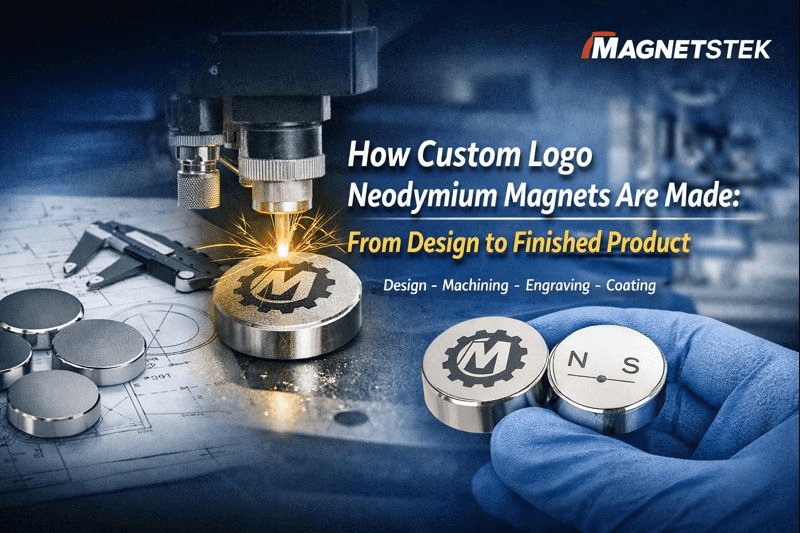
Custom logo neodymium magnets are more than simple magnetic components. They combine high magnetic performance, precision manufacturing, and brand identification into a single engineered part. For OEM manufacturers, automation integrators, equipment builders, and brand owners, these magnets serve not only a functional role but also a permanent and durable branding solution.
This article explains, step by step, how custom round neodymium magnets with logos are made, from early design considerations to the final finished product, with a focus on industrial-grade manufacturing practices used by Magnetstek.
1. Understanding the Purpose of Custom Logo Neodymium Magnets
Before production begins, it is essential to define why a logo is added to a neodymium magnet. Unlike printed labels or adhesives, logos on magnets are typically permanent, resistant to wear, and compatible with harsh environments.
Common objectives include:
- Product or brand identification in OEM assemblies
- Anti-counterfeiting or traceability
- Orientation or polarity marking
- Aesthetic enhancement for commercial or promotional products
Because neodymium magnets are often used in industrial, automotive, medical, and automation systems, the logo must not compromise magnetic performance, mechanical strength, or corrosion resistance.
2. Design Phase: Defining Specifications and Constraints
The design phase is the foundation of a successful custom magnet project. At Magnetstek, this stage focuses on balancing branding requirements with magnetic and mechanical performance.
2.1 Magnet Geometry and Dimensions
Most logo magnets are produced in round (disc or cylinder) shapes, which are easy to machine, coat, and engrave. Typical parameters include:
- Diameter and thickness
- Tolerance requirements
- Flatness and parallelism
The logo is usually placed on one flat surface, leaving the opposite face untouched to preserve maximum magnetic contact.
2.2 Magnetic Grade Selection
Neodymium magnets are available in various grades (e.g., N35–N56), each offering different levels of magnetic strength and temperature resistance.
Key factors influencing grade selection:
- Required holding force or flux density
- Operating temperature
- Environmental exposure
- Cost-performance balance
Higher grades provide stronger magnetic output but may require stricter process control during machining and engraving.
2.3 Logo Design Considerations
Logos can be:
- Text (brand name, part number, country of origin)
- Simple icons or symbols
- Orientation arrows or polarity indicators
Design rules typically include:
- Minimum line width and depth
- Avoiding sharp internal corners
- Maintaining sufficient spacing from edges
These rules help ensure clean engraving without weakening the magnet.
3. Raw Material Preparation: NdFeB Magnet Production
Custom logo magnets begin as sintered neodymium iron boron (NdFeB) blanks. The production of these blanks is a highly controlled metallurgical process.
3.1 Powder Metallurgy and Sintering
NdFeB magnets are manufactured using powder metallurgy:
- Alloy melting and strip casting
- Hydrogen decrepitation and jet milling
- Magnetic alignment under strong fields
- Vacuum sintering and heat treatment
This process determines the intrinsic magnetic properties of the magnet.
3.2 Machining to Final Shape
Sintered NdFeB is extremely hard and brittle. Precision machining is required to achieve:
- Exact round dimensions
- Smooth surfaces for coating and engraving
- Tight tolerances for OEM assemblies
Diamond grinding tools are commonly used to minimize chipping and microcracks.
4. Logo Application Methods: Choosing the Right Technique
The logo application step is critical, as it directly affects appearance, durability, and magnetic performance.
4.1 Laser Engraving (Most Common Method)
Laser engraving is the preferred method for industrial logo magnets.
Advantages:
- Non-contact process
- High precision and repeatability
- No chemical residues
- Suitable for mass production
The laser removes a shallow layer of material, creating a permanent mark without significantly affecting magnetic strength.
4.2 Stamping or Mechanical Marking
In some cases, shallow mechanical marking may be used for:
- Simple polarity dots
- Low-detail symbols
However, this method carries a higher risk of microcracks and is less suitable for brittle NdFeB materials.
4.3 Ink or Paint Marking (Limited Use)
Painted logos are typically used only for temporary identification, as they:
- Wear off over time
- Are not solvent-resistant
- Are unsuitable for harsh environments
For most Magnetstek customers, laser engraving remains the optimal solution.
5. Surface Coating: Protecting the Magnet and Logo
Neodymium magnets are highly susceptible to corrosion. Proper surface coating is essential, especially after logo engraving.
5.1 Common Coating Options
- Nickel–Copper–Nickel (NiCuNi)
- Epoxy coating
- Zinc coating
- Black nickel or decorative finishes
The choice depends on:
- Environmental exposure
- Required appearance
- Compatibility with engraving depth
5.2 Coating After Engraving
Logos are typically engraved before final coating. This allows the coating to:
- Seal exposed NdFeB material
- Improve corrosion resistance
- Enhance contrast between logo and surface
This step is critical for long-term durability.
6. Magnetization: Activating Magnetic Performance
Once coating is complete, the magnets are magnetized using high-field magnetizing fixtures.
6.1 Magnetization Direction
For round magnets with logos, magnetization is usually:
- Axial (through thickness)
- Carefully oriented to align logo position if required
Some customers request the logo to indicate:
- North or South pole
- Installation orientation
6.2 Quality Control of Magnetization
Each batch undergoes:
- Magnetic flux testing
- Pull force verification
- Polarity inspection
This ensures consistency across all units.
7. Quality Control and Inspection
Magnetstek applies multi-stage inspection to ensure both magnetic and visual quality.
7.1 Dimensional and Visual Inspection
- Diameter and thickness measurement
- Logo clarity and depth check
- Surface defect inspection
7.2 Magnetic Performance Testing
- Surface field strength
- Pull force testing
- Batch consistency evaluation
7.3 Reliability Considerations
For critical applications, additional tests may include:
- Salt spray testing
- Thermal cycling
- Adhesion testing for coatings
8. Packaging and Handling for Logo Magnets
Logo magnets are often customer-facing components, so packaging matters.
Typical packaging solutions include:
- Individual separators to prevent chipping
- Anti-corrosion bags
- Custom trays or blister packs
- OEM-labeled cartons
Proper packaging protects both the magnetic properties and the visual appearance of the logo.
9. Applications of Custom Logo Neodymium Magnets
Custom logo magnets are widely used across industries:
- Automation equipment and fixtures
- Automotive components
- Medical devices and instruments
- Electronics housings
- Promotional and branded hardware
In many cases, the logo provides traceability, authenticity, and professional appearance throughout the product lifecycle.
10. Why Work with Magnetstek for Custom Logo Magnets
Producing custom logo neodymium magnets requires more than engraving capability. It demands:
- Deep understanding of magnetic materials
- Precision machining expertise
- Reliable quality control systems
- OEM-oriented customization support
Magnetstek specializes in custom-engineered neodymium magnets, offering:
- Flexible logo customization
- Wide grade and coating options
- OEM and bulk production capability
- Engineering support from design to delivery
Conclusion
Custom logo neodymium magnets represent a perfect integration of functionality and branding. From material selection and precision machining to laser engraving, coating, magnetization, and inspection, every step must be carefully controlled to ensure performance and durability.
By understanding the complete manufacturing process, buyers can make informed decisions and achieve reliable, professional results. With experienced engineering support and strict quality control, Magnetstek delivers custom logo magnets that meet both technical requirements and brand expectations.