

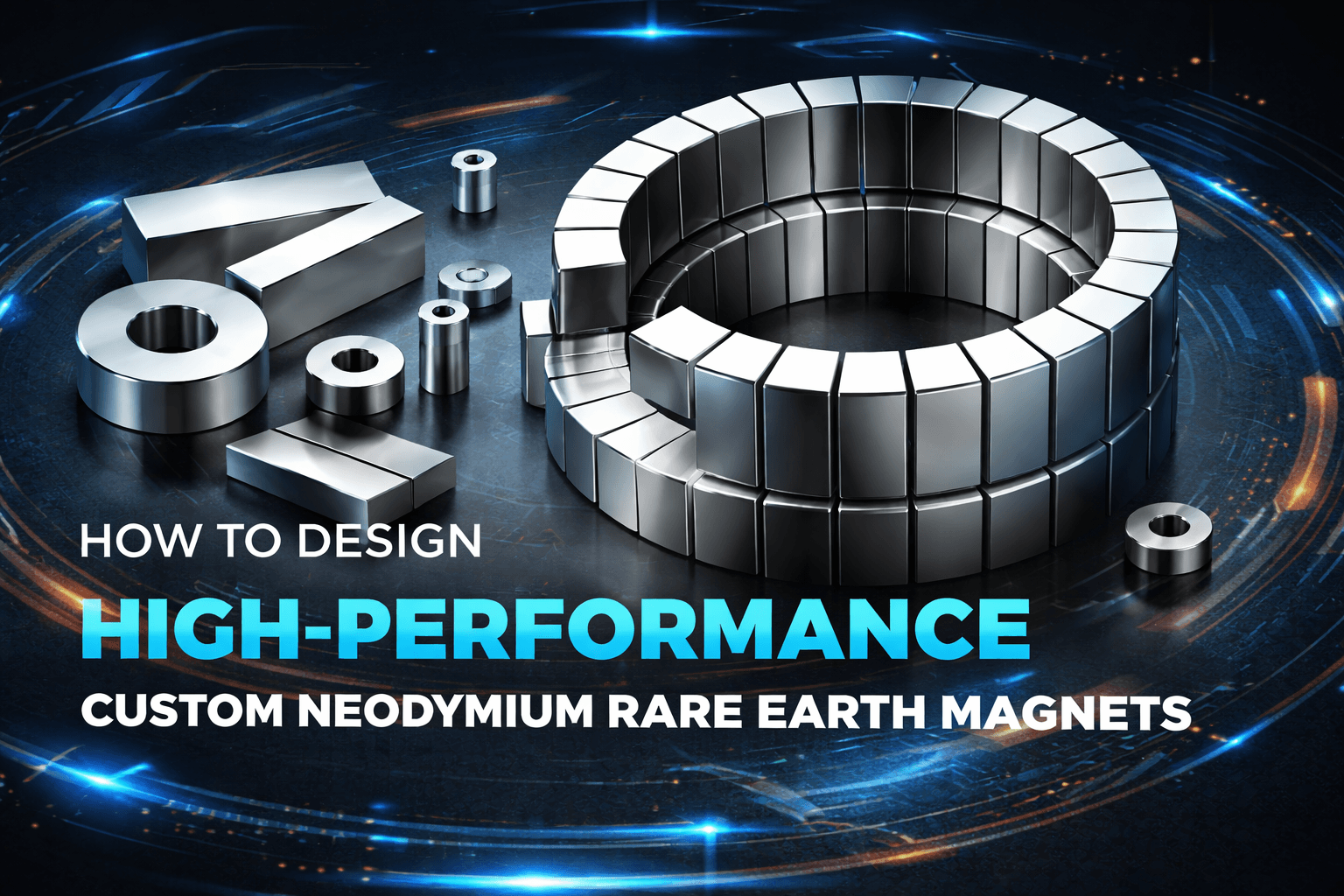
Designing high-performance custom neodymium magnets is not simply about choosing the highest grade available. It requires a systematic understanding of magnetic physics, material science, mechanical constraints, thermal behavior, corrosion protection, manufacturing tolerances, and the final system environment. In advanced applications—high-speed motors, medical devices, robotics, aerospace actuators, precision sensors—the magnet is not a standalone component. It is a functional part of a magnetic circuit.
This guide provides a comprehensive engineering framework for designing high-performance custom NdFeB magnets, covering magnetic properties, geometry, magnetization methods, temperature management, coating systems, mechanical integration, and failure prevention.
1. Understanding the Fundamentals of NdFeB Magnets
Neodymium magnets are based on the Nd₂Fe₁₄B intermetallic compound, discovered in the 1980s. They are classified as rare-earth permanent magnets and offer the highest energy product among commercially available magnet materials.
Key characteristics:
- Extremely high remanence (Br)
- High coercivity (Hc and Hcj)
- High maximum energy product (BHmax)
- Compact size for high torque density
- Brittle ceramic-like mechanical behavior
- Moderate corrosion resistance without coating
To design a high-performance custom magnet, engineers must understand the core magnetic parameters.
2. Core Magnetic Parameters and Their Design Impact
2.1 Remanence (Br)
Remanence is the residual magnetic flux density when the magnetizing field is removed. Higher Br means stronger magnetic field output.
Typical range:
- N35: ~1.17 T
- N52: ~1.48 T
- N56: approaching ~1.6 T
Higher Br enables:
- Higher motor torque density
- Stronger holding force
- Reduced magnet volume
However, higher Br grades often have lower intrinsic coercivity and lower temperature stability.
2.2 Coercivity (Hc and Hcj)
- Hc: Resistance to demagnetization
- Hcj: Intrinsic coercivity (critical for high temperature applications)
High coercivity is essential when:
- Operating at elevated temperature
- Exposed to strong opposing magnetic fields
- Used in compact high-flux motor designs
Design rule:
If temperature or reverse field is present, prioritize Hcj over Br.
2.3 Maximum Energy Product (BHmax)
BHmax defines the maximum magnetic energy stored per unit volume.
Higher BHmax allows:
- Smaller magnet size
- Higher torque density
- Improved efficiency
However:
- Higher energy grades cost more
- Thermal stability must be evaluated
3. Selecting the Correct Magnet Grade
Magnet grades range from N35 to N56 and temperature-enhanced grades like:
- NxxH
- NxxSH
- NxxUH
- NxxEH
- NxxAH
3.1 Standard vs High Temperature Grades
| Grade Type | Max Operating Temp |
|---|---|
| N | ~80°C |
| H | ~120°C |
| SH | ~150°C |
| UH | ~180°C |
| EH | ~200°C |
| AH | ~230°C |
High-temperature grades contain added heavy rare earth elements such as Dysprosium (Dy) or Terbium (Tb), increasing Hcj but slightly reducing Br.
Design insight:
Do not over-specify grade. Choose the lowest grade that safely meets magnetic and thermal requirements to control cost.
4. Geometry Optimization for Performance
Magnet shape significantly influences performance and magnetic flux distribution.
4.1 Common Shapes
- Disc
- Block
- Ring
- Arc segment
- Radially magnetized ring
- Custom irregular geometries
4.2 Aspect Ratio Considerations
Longer magnet length in magnetization direction reduces demagnetization risk.
Rule:
Length ≥ 0.7 × diameter (for discs) improves stability.
Thin magnets:
- Higher demagnetization risk
- Strong edge field concentration
- Greater mechanical fragility
5. Magnetization Direction and Multi-Pole Design
5.1 Axial Magnetization
- Most common
- Magnetic poles on flat surfaces
- Used in holding magnets and actuators
5.2 Diametric Magnetization
- Poles on curved sides
- Used in rotating systems
5.3 Radial Magnetization
- Essential for high-efficiency motors
- Provides uniform air gap flux
- Requires specialized magnetizing fixtures
5.4 Multi-Pole Magnetization
- Improves torque smoothness
- Reduces cogging
- Common in encoders and BLDC motors
Engineering note:
Magnetization must be defined during design stage. Post-machining magnetization ensures precise field orientation.
6. Magnetic Circuit Design
High-performance magnets function within a magnetic circuit.
A magnetic circuit includes:
- Magnet
- Air gap
- Back iron (soft magnetic material)
- Housing
- Rotor/stator components
6.1 Use of Back Iron
Low carbon steel or 430 stainless steel:
- Concentrates flux
- Reduces leakage
- Enhances field strength
6.2 Air Gap Optimization
Magnetic flux decreases rapidly with distance.
Minimize air gap while:
- Allowing thermal expansion
- Avoiding mechanical contact
In high-speed motors:
Air gap precision directly affects efficiency and torque ripple.
7. Thermal Design and Demagnetization Prevention
Temperature is the primary risk factor in NdFeB performance.
7.1 Temperature Coefficients
Typical:
- Br decreases ~0.10–0.12% per °C
- Hcj decreases more significantly
Example:
If a magnet operates at 150°C, flux loss can be substantial unless high-temperature grade is selected.
7.2 Permanent vs Reversible Loss
Reversible loss:
- Flux returns after cooling
Irreversible loss:
- Permanent demagnetization
- Occurs if operating point crosses demagnetization curve knee
Design margin:
Ensure operating point stays well above knee point at maximum temperature.
7.3 Thermal Management Strategies
- Use heat sinks
- Increase ventilation
- Add thermal conduction path
- Select higher Hcj grade
8. Mechanical Integration and Structural Design
NdFeB magnets are brittle.
Design considerations:
- Avoid tensile stress
- Use compressive mounting where possible
- Avoid sharp corners
- Consider chamfered edges
8.1 High-Speed Rotors
For >5,000 rpm:
- Use retaining sleeves (carbon fiber, stainless steel, titanium)
- Account for centrifugal force
- Perform rotor dynamic balancing
9. Surface Coating and Corrosion Protection
NdFeB contains iron and oxidizes easily.
9.1 Common Coatings
| Coating | Features |
|---|---|
| Ni-Cu-Ni | Standard, good wear resistance |
| Zn | Economical |
| Epoxy | High corrosion resistance |
| Phosphate | Basic protection |
| Gold | Decorative or medical |
For humid or marine environments:
Epoxy or multilayer coatings recommended.
10. Precision Machining and Tolerance Control
Magnets are typically machined before magnetization.
Typical tolerance:
±0.05 mm to ±0.1 mm
Post-magnetization machining:
Difficult and dangerous.
Design recommendation:
Finalize dimensions before magnetization.
11. Finite Element Analysis (FEA) in Magnet Design
Modern magnet design relies on simulation.
Software tools:
- ANSYS Maxwell
- COMSOL
- JMAG
Simulations help evaluate:
- Flux density distribution
- Temperature effects
- Demagnetization risk
- Torque output
- Leakage flux
FEA reduces prototyping cost and development time.
12. Special Design: Halbach Arrays
Halbach arrays enhance field on one side while canceling on the opposite side.
Benefits:
- Increased flux density
- Reduced back iron
- Improved motor efficiency
Applications:
- High-speed rotors
- Magnetic bearings
- Linear motors
Design requires:
Precise orientation and assembly.
13. Failure Analysis and Risk Mitigation
Common failure modes:
- Cracking
- Demagnetization
- Corrosion
- Adhesive failure
Mitigation strategies:
- Use adequate safety factors
- Control temperature
- Proper coating selection
- Controlled assembly process
14. Cost Optimization Without Performance Loss
High performance does not always mean highest grade.
Cost drivers:
- Rare earth content
- Grade level
- Coating type
- Tolerance requirements
- Magnetization complexity
Optimization strategy:
Balance grade, geometry, and magnetic circuit design rather than overspecifying magnet strength.
15. Customization Workflow for High-Performance Design
Step-by-step process:
- Define application requirements
- Torque / Force
- Temperature
- Speed
- Environment
- Select preliminary grade
- Design geometry
- Simulate magnetic circuit
- Evaluate thermal margin
- Choose coating
- Prototype and test
- Refine design
- Prepare mass production validation
16. Case Study: High-Speed BLDC Rotor Design
Application:
7,000 rpm compact motor
Design goals:
- Maximize outward flux
- Maintain thermal stability
- Prevent rotor burst
Solutions:
- Radially magnetized arc segments
- High Hcj grade (SH or UH)
- Titanium sleeve containment
- Precision balancing
- FEA demagnetization check
Result:
Improved torque density and long-term stability.
17. Emerging Trends in High-Performance NdFeB Design
- Heavy rare earth reduction via grain boundary diffusion
- Ultra-high grade (N56 and above)
- Cryogenic magnetization
- Additive manufacturing of magnetic circuits
- Hybrid magnet systems (NdFeB + SmCo)
Conclusion
Designing high-performance custom neodymium magnets requires a multidisciplinary approach combining magnetic physics, thermal engineering, mechanical design, corrosion science, and cost control. The strongest magnet is not always the best magnet. The optimal design is one that meets performance requirements with sufficient safety margin, thermal stability, structural integrity, and long-term reliability.
By carefully selecting grade, optimizing geometry, managing temperature, designing an efficient magnetic circuit, and validating through simulation and testing, engineers can create highly reliable, compact, and efficient magnetic systems for advanced applications.
A well-designed custom NdFeB magnet is not just a component—it is an engineered solution that directly determines system efficiency, durability, and competitive advantage.