Introduction
When engineers develop a miniature magnetic assembly, they often need magnet samples quickly. At the early prototype stage, the final design may not be fully fixed, and the engineering team may simply need a small ring magnet that is close enough to test fit, magnetic response, sensor position, or assembly function.
This is where stock micro ring magnets become useful.
A typical inquiry may look like this:
We are looking for stock micro magnets: OD 3 mm × ID 1 mm × H 3 mm. OD can be larger. ID is most fixed. Thickness can be different from 3 mm. Material can be SmCo, NdFeB, or ferrite. Do you have anything like that in stock? How much time will it take to receive samples?
This type of request is common in research, sensor development, encoder testing, miniature motor design, medical device component development, robotics, and precision mechanism prototyping. The customer is not necessarily asking for a fully customized production magnet. Instead, they want to know whether a close stock size is available for fast evaluation.
This guide explains how buyers can search for the closest available micro ring magnet, which dimensions matter most, how material options affect selection, and when it is better to move from stock samples to custom production.
What Are Micro Ring Magnets?
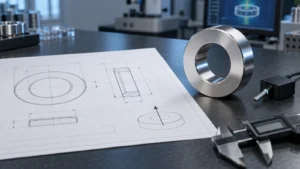
Micro ring magnets are small permanent magnets with a circular outer diameter and a center hole. They may also be called:
- Miniature ring magnets
- Micro tube magnets
- Small bore magnets
- Micro NdFeB ring magnets
- SmCo micro ring magnets
- Ferrite micro ring magnets
- Precision ring magnets
A ring magnet is usually described by three key dimensions:
| Dimension | Meaning |
|---|---|
| OD | Outer Diameter |
| ID | Inner Diameter |
| H / T / L | Height, thickness, or length |
For example, OD 3 mm × ID 1 mm × H 3 mm means the magnet has a 3 mm outside diameter, a 1 mm center hole, and a 3 mm height.
In micro magnet projects, these dimensions are small enough that even minor changes can affect fit, magnetic field, coating, and handling. That is why buyers should clearly state which dimensions are fixed and which dimensions can be flexible.
Why Stock Sizes Matter During Prototyping
Custom micro magnets can be produced according to drawing, but custom production usually requires additional time for engineering review, material preparation, machining, coating, magnetization, inspection, and packaging. For early-stage prototyping, this may not always be necessary.
Stock or near-stock micro ring magnets can help engineers:
- Test mechanical fit quickly
- Verify sensor response
- Check approximate magnetic field strength
- Evaluate assembly clearance
- Compare different materials
- Reduce early development lead time
- Avoid custom tooling before design freeze
- Identify whether the design needs stronger or weaker magnets
In many prototype projects, the first goal is not to obtain the final perfect magnet. The goal is to test whether the basic design direction works.
If a close stock size can perform well enough for early testing, the customer can save time before committing to a final custom magnet.
Which Dimension Matters Most?
In the example request, the customer says:
“ID is most fixed.”
This is an important technical detail. It means the 1 mm inner diameter is the most critical dimension. The outer diameter can be larger, and the height can be different from 3 mm.
This tells the supplier how to search stock options.
Instead of only searching for:
OD 3 × ID 1 × H 3 mm
the supplier can also check:
- OD 3 × ID 1 × H 2 mm
- OD 3 × ID 1 × H 4 mm
- OD 4 × ID 1 × H 2 mm
- OD 4 × ID 1 × H 3 mm
- OD 5 × ID 1 × H 3 mm
- OD 5 × ID 1 × H 4 mm
If the ID must fit a shaft, pin, screw, guide wire, optical element, or plastic post, then the inner diameter is usually difficult to change. If the ID is too small, the magnet cannot be installed. If the ID is too large, the magnet may be loose, misaligned, or unstable.
OD and height often have more flexibility, depending on the available space and magnetic strength required.
Understanding OD, ID, and Height Trade-Offs
Inner Diameter
The inner diameter controls how the magnet fits around another part. In micro assemblies, the ID often interacts with a shaft, pin, tube, needle, sensor axis, or positioning post.
A fixed ID should be clearly stated in the RFQ. Buyers should also clarify whether the ID is required before or after coating.
For very small magnets, coating thickness can reduce the final hole size. A 1 mm ID is already small, so coating buildup may be important.
Outer Diameter
The outer diameter affects both mechanical fit and magnetic volume. A larger OD usually provides more magnetic material, which may increase the magnetic field. However, it also requires more space in the assembly.
If the customer says “OD can be larger,” the supplier can search a wider range of stock options. This increases the chance of finding samples quickly.
Height
Height affects magnetic performance and how the magnet fits in the assembly. A taller magnet usually has more magnetic volume, but it may not fit if the available vertical space is limited.
If the customer accepts different thickness or height, stock selection becomes easier.
Material Options: NdFeB, SmCo, or Ferrite
The customer may not always know which magnet material is best for prototype testing. In the example request, three material options are acceptable: SmCo, NdFeB, or ferrite.
Each material has different advantages.
| Material | Magnetic Strength | Temperature Stability | Corrosion Resistance | Stock Availability in Micro Sizes | Typical Use |
|---|---|---|---|---|---|
| NdFeB | Very high | Grade dependent | Usually needs coating | Often better | Compact prototypes, sensors, small mechanisms |
| SmCo | High | Excellent | Better than NdFeB | More limited | High-temperature sensors, precision devices |
| Ferrite | Low to medium | Good | Good | Limited in very small sizes | Low-cost, low-force applications |
NdFeB Micro Ring Magnets
NdFeB is usually the first material to check when the design needs strong magnetic performance in a compact size. It is commonly used in miniature sensors, compact magnetic couplings, encoders, and precision mechanisms.
However, NdFeB normally requires coating, such as Ni-Cu-Ni, epoxy, or other surface protection.
SmCo Micro Ring Magnets
SmCo is useful when the application requires better temperature stability or corrosion resistance. It is often selected for high-temperature or harsh-environment applications.
The limitation is that SmCo micro ring magnets may be less commonly stocked than NdFeB sizes.
Ferrite Micro Ring Magnets
Ferrite magnets are cost-effective and corrosion resistant, but their magnetic strength is much lower than NdFeB. At very small sizes, ferrite may not provide enough field strength for some sensor or holding applications.
Ferrite micro ring magnets may also be harder to find in very small stocked dimensions.
Magnetization Direction Must Be Confirmed
A stock magnet is only useful if its magnetization direction matches the prototype requirement. For ring magnets, possible magnetization directions may include:
- Axial magnetization
- Diametrical magnetization
- Radial magnetization
- Multi-pole magnetization
Most standard small ring magnets are often axially magnetized, with north and south poles on the two flat faces. This may be suitable for many basic prototype tests.
However, sensor and encoder applications may need diametrical, radial, or multi-pole magnetization. These are less likely to be available from stock and may require custom production.
Buyers should not assume that any ring magnet with the right dimensions will work. A magnet with the wrong magnetization direction may produce a completely different field pattern.
A useful RFQ sentence is:
Available stock magnetization is acceptable for initial testing, but please confirm whether the magnet is axial, diametrical, radial, or multi-pole magnetized.
Coating and Final Fit
For micro ring magnets, coating should not be ignored. NdFeB magnets usually need coating to protect against corrosion. Common coating options include:
- Ni-Cu-Ni
- Epoxy
- Zinc
- Gold
- Parylene
- Phosphate
For stock samples, the available coating may already be fixed. The buyer should confirm whether the coating is acceptable for testing.
With very small ring magnets, coating affects final size. It can change:
- Outer diameter
- Inner diameter
- Surface finish
- Hole clearance
- Bonding behavior
- Assembly fit
If the ID is fixed at 1 mm, the buyer should confirm whether that means final ID after coating. This is especially important if the magnet must slide over a pin or shaft.
Stock Sample Lead Time
Sample lead time depends on whether a suitable magnet is actually available in stock.
There are usually three situations.
1. Exact Stock Available
If the supplier has the exact size, material, coating, and magnetization in stock, samples can usually be prepared quickly after quotation confirmation. The remaining time mainly depends on packing, export handling, and shipping method.
2. Close Stock Size Available
If a close size is available, the supplier can provide the nearest option for prototype testing. This is often the fastest practical solution when the customer allows OD or height flexibility.
3. Custom Production Required
If no suitable stock size exists, or if the magnetization direction, coating, tolerance, or material is special, custom production may be required. This will take longer because the magnets must be manufactured, coated, magnetized, inspected, and packed.
Buyers can shorten lead time by clearly stating which requirements are flexible.
Stock vs Custom Micro Ring Magnets
| Factor | Stock Micro Ring Magnets | Custom Micro Ring Magnets |
|---|---|---|
| Best for | Early prototyping | Final design or production |
| Lead time | Faster if available | Longer |
| Size flexibility | Limited to available sizes | Made to drawing |
| Material options | Limited | More flexible |
| Magnetization | Usually fixed | Can be specified |
| Coating | Usually fixed | Can be selected |
| Cost | Lower for samples | Higher setup cost |
| Precision | Stock tolerance | Drawing-based tolerance |
Stock magnets are useful when speed matters. Custom magnets are better when the design is already fixed and the magnet must meet specific size, coating, magnetization, or performance requirements.
How to Search for the Closest Available Size
When looking for stock micro ring magnets, buyers should provide both the target size and acceptable alternatives.
For example:
Target size: OD 3 mm × ID 1 mm × H 3 mm
Acceptable alternatives: OD larger acceptable, ID 1 mm preferred, height 2–4 mm acceptable
Material: NdFeB, SmCo, or ferrite acceptable
Purpose: Prototype testing
This allows the supplier to search stock more efficiently.
A supplier may then check options such as:
| Option | Possible Use |
|---|---|
| OD 3 × ID 1 × H 2 mm | Closest lower height |
| OD 3 × ID 1 × H 4 mm | Same OD/ID, taller option |
| OD 4 × ID 1 × H 3 mm | Larger OD, same ID and height |
| OD 5 × ID 1 × H 3 mm | More magnetic volume |
| OD 4 × ID 1.2 × H 3 mm | Possible only if ID tolerance allows |
| OD 3 × ID 1 × H 3 mm custom | Final custom production if no stock |
The more flexibility the buyer provides, the higher the chance of finding a fast sample option.
What Buyers Should Provide in an RFQ
A good RFQ for stock micro ring magnets should include:
| RFQ Item | Example |
|---|---|
| Target Size | OD 3 mm × ID 1 mm × H 3 mm |
| Critical Dimension | ID 1 mm is most fixed |
| Flexible Dimension | OD can be larger; height can be 2–4 mm |
| Material | NdFeB, SmCo, or ferrite acceptable |
| Magnetization | Please advise available stock magnetization |
| Coating | Stock coating acceptable, please specify |
| Quantity | Samples first |
| Application | Prototype for sensor or miniature assembly |
| Destination | Country or delivery location |
| Urgency | Required sample timing |
| Custom Option | Please advise if custom production is needed |
The most important thing is to tell the supplier what can change and what cannot change.
Example RFQ for Faster Response
A clear RFQ may look like this:
Product: Stock micro ring magnet
Target size: OD 3 mm × ID 1 mm × H 3 mm
Critical dimension: ID 1 mm is most important
Flexible dimensions: OD can be larger; height can be different from 3 mm, preferably 2–4 mm
Material: NdFeB, SmCo, or ferrite acceptable
Magnetization: Please advise available stock magnetization direction
Coating: Stock coating acceptable, please specify
Quantity: Samples first
Application: Prototype testing for miniature magnetic assembly
Request: Please provide available stock or nearest standard sizes, sample quantity, price, and estimated delivery time.
This gives the supplier enough information to check stock quickly.
When to Move from Stock Samples to Custom Production
Stock samples are useful for early testing, but they may not be suitable for final production. After prototype testing, custom magnets may be required if:
- The final OD must be controlled tightly
- The ID must fit a precise shaft or pin
- Height must match a fixed assembly space
- A specific material grade is required
- A special coating is needed
- Magnetization direction must be customized
- Surface field or flux must meet a target
- Polarity marking is required
- Packaging must follow production requirements
At that stage, the buyer should provide a drawing and final specifications.
FAQ
What are stock micro ring magnets?
Stock micro ring magnets are small ring-shaped magnets available from existing inventory or standard production sizes. They are useful for quick prototype testing when exact custom dimensions are not yet required.
What does OD 3 × ID 1 × H 3 mm mean?
It means the magnet has a 3 mm outer diameter, a 1 mm inner diameter, and a 3 mm height or thickness.
Why is ID often the most critical dimension?
The inner diameter usually determines whether the magnet can fit over a shaft, pin, screw, or positioning feature. If the ID is wrong, the magnet may not assemble correctly.
Can OD be larger during prototype testing?
Yes, if the assembly has enough space. A larger OD may also provide stronger magnetic output because it increases magnetic material volume.
Can height be different from the target size?
Yes, if the design allows it. A different height may affect magnetic strength and fit, but it can be acceptable for early prototype evaluation.
Which material is best for micro ring magnets?
NdFeB is usually preferred for strong magnetic performance. SmCo is better for high-temperature stability. Ferrite may be used when lower magnetic strength is acceptable.
Are SmCo micro ring magnets usually available from stock?
They may be available in some sizes, but stock options are often more limited than NdFeB. Availability depends on size, grade, and supplier inventory.
Does magnetization direction matter for prototype samples?
Yes. A stock magnet with the wrong magnetization direction may not work in the prototype. Buyers should ask the supplier to confirm the magnetization direction.
How fast can samples be received?
It depends on stock availability, sample preparation, export handling, shipping method, and destination. Exact stock samples are usually faster than custom-made samples.
When should custom production be considered?
Custom production should be considered when the final design requires exact dimensions, tight tolerance, special material, specific coating, custom magnetization, or production-level consistency.
Conclusion
Stock micro ring magnets can be a practical solution for prototype testing when engineers need samples quickly and can accept some flexibility in size, material, or height. For requests such as OD 3 mm × ID 1 mm × H 3 mm, the most important step is to identify which dimension is truly fixed. In many miniature assemblies, the inner diameter is the most critical feature because it determines mechanical fit.
If the customer can accept a larger OD, different height, or flexible material such as NdFeB, SmCo, or ferrite, the chance of finding a suitable stock or near-stock magnet increases significantly. However, magnetization direction, coating, and final fit should still be confirmed before testing.
Magnetstek supports stock and custom micro ring magnets for prototype and production applications. Send us your target size, acceptable alternative dimensions, material preference, magnetization direction, quantity, and application details, and our team can help check the closest available stock size or recommend a custom production route.