


1. Introduction
Many engineers and buyers encounter the same issue: the magnet performs well on paper but fails in real applications. Whether it’s insufficient holding force, weak attraction, or unstable performance, the root cause is rarely just “magnet strength.”
In most cases, the problem lies in design, environment, or system integration rather than the magnet itself. This guide provides a practical troubleshooting framework to help you identify and fix the issue efficiently.
2. Start with the Right Question
Before changing the magnet, clarify the failure mode:
- Is the pull force lower than expected?
- Does the magnet lose strength over time?
- Is performance inconsistent across batches?
- Does it fail only under temperature or vibration?
👉 Each symptom points to a different root cause.
3. The Most Common Causes (and Fixes)
3.1 Air Gap: The #1 Hidden Problem
Even a tiny air gap can dramatically reduce magnetic force.
Why it matters:
- Magnetic force drops exponentially with distance
- A 0.5 mm gap can reduce force by 30–70%
Typical causes:
- Surface roughness
- Coating thickness
- Dust or oxide layers
- Misalignment
Solutions:
- Improve surface flatness
- Reduce coating thickness if possible
- Use compliant layers or preload
- Ensure full contact between surfaces
3.2 Wrong Magnet Grade
Not all magnets labeled “strong” perform the same.
Key parameters:
- Br (Residual Flux Density) → affects strength
- Hcj (Intrinsic Coercivity) → affects stability
- BHmax → overall energy
Common mistake:
Using N35 when N52 is required—or worse, using high Br but low temperature grade.
Solutions:
- Upgrade grade (e.g., N42 → N52)
- For high temperature: use H, SH, UH, EH grades
- Consider SmCo for extreme environments
3.3 Magnet Size and Geometry
Magnet strength is not just about material—it’s also about shape.
Key factors:
- Thickness vs diameter
- Aspect ratio
- Contact area
Common issue:
Thin magnets saturate quickly and produce weaker external fields.
Solutions:
- Increase thickness (often more effective than area)
- Optimize shape for flux direction
- Use ring or block depending on application
3.4 Missing Steel Backing Plate
A magnet alone is often inefficient.
Why it matters:
- Steel backing redirects magnetic flux
- Can increase holding force by 2–3×
Solutions:
- Add low-carbon steel backing
- Use magnetic circuit design (closed loop)
- Avoid stainless steels with low permeability
3.5 Incorrect Magnetization Direction
This is a surprisingly common issue.
Types:
- Axial magnetization
- Radial magnetization
- Multi-pole magnetization
Problem:
Using axial when radial is required (especially in motors)
Solutions:
- Confirm magnetization direction before ordering
- Use simulation or drawings
- For rings: consider radial magnetization
3.6 Temperature Effects
Magnets lose strength as temperature increases.
Example:
- NdFeB loses ~0.1–0.12% per °C
- Above max temp → irreversible loss
Solutions:
- Choose high-temperature grades
- Switch to SmCo for >200°C
- Improve thermal management
3.7 Coating and Corrosion
Corrosion can degrade magnetic performance over time.
Issues:
- NdFeB is highly reactive
- Poor coating → oxidation → loss of material
Solutions:
- Use Ni-Cu-Ni, Epoxy, or Parylene coatings
- Select coating based on environment (humidity, salt spray)
3.8 Misleading Pull Force Data
Catalog values are often ideal conditions.
Typical assumptions:
- Thick steel plate
- Perfect contact (no air gap)
- Room temperature
Reality:
Your application likely differs.
Solutions:
- Perform real-world testing
- Apply safety factor (typically 2–3×)
- Request custom testing data
4. Magnetic Circuit Optimization


4
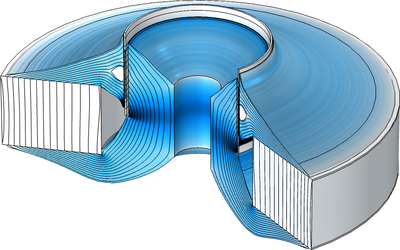
Instead of increasing magnet size, optimize the magnetic circuit.
Key strategies:
- Use steel yokes to form closed loops
- Minimize air gaps
- Align flux paths
- Avoid leakage
👉 A well-designed circuit can outperform a larger magnet.
5. Quick Troubleshooting Checklist
Use this checklist when diagnosing weak magnet performance:
| Issue | Likely Cause | Solution |
|---|---|---|
| Weak holding force | Air gap | Improve contact |
| Works in lab, fails in field | Temperature | Upgrade grade |
| Inconsistent performance | Coating or corrosion | Improve coating |
| Weak attraction | No backing plate | Add steel |
| Poor motor performance | Wrong magnetization | Redesign orientation |
6. When to Consider Custom Magnets
If standard magnets fail, customization may be required:
- Custom shape (arc, segment, ring)
- Special magnetization patterns
- Tight tolerances
- Assembly integration
👉 For motor, sensor, or medical applications, custom design is often essential.
7. Conclusion
If your magnet isn’t strong enough, the issue is rarely just “insufficient strength.”
It’s usually a combination of:
- Air gap
- Design inefficiency
- Material mismatch
- Environmental factors
By systematically analyzing these variables, you can significantly improve performance without necessarily increasing cost.
8. Need Help with Your Magnet Design?
If you’re facing performance issues:
- Share your application details or drawings
- Specify working temperature and environment
- Describe the required force or field
Our engineering team can help you:
- Optimize magnet selection
- Design magnetic circuits
- Provide custom magnet solutions
📩 Contact: [email protected]
You May Also Want to Know
1. Why does my magnet feel weaker than expected?
Because real conditions differ from ideal test conditions (air gap, surface, temperature).
2. Is a higher grade magnet always better?
Not necessarily—temperature stability and design matter more.
3. How can I increase holding force without changing size?
Add a steel backing plate or optimize the magnetic circuit.
4. Do coatings affect magnetic strength?
Indirectly—thick coatings increase air gap.
5. What is the best magnet for high temperature?
SmCo magnets or high-grade NdFeB (e.g., SH, UH).
6. Can I stack magnets to increase strength?
Yes, but only effective if aligned correctly.
7. What causes magnets to crack?
Mechanical stress, brittleness of NdFeB, or improper handling.
8. How do I test magnet strength accurately?
Use pull force testers under controlled conditions.
9. Are radial magnets stronger than axial ones?
Not stronger, but more suitable for specific applications like motors.
10. When should I use custom magnets?
When standard sizes or performance cannot meet your requirements.