Introduction
NdFeB disc magnets are widely used in sensors, motors, magnetic couplings, positioning devices, encoders, holding systems, and compact mechanical assemblies. Most standard disc magnets are axially magnetized, meaning the north and south poles are located on the two flat faces of the magnet. However, some applications require a different magnetic field direction. In these cases, engineers may specify a diametrically magnetized NdFeB disc magnet.
A diametrically magnetized disc magnet has its north and south poles positioned on opposite sides of the curved outer diameter. Instead of the magnetic field passing through the thickness of the disc, the magnetic field passes across the diameter. This magnetization direction is critical in applications where rotational position, angular sensing, radial field distribution, or side-facing magnetic interaction is required.
Because diametrical magnetization is less common than axial magnetization, it must be clearly specified during quotation and production. A magnet with the same material, size, coating, and grade can behave very differently if the magnetization direction is changed. This guide explains how diametrically magnetized NdFeB disc magnets work, where they are used, and what information should be provided when requesting a custom quote.
What Is a Diametrically Magnetized Disc Magnet?
A diametrically magnetized disc magnet is a round NdFeB magnet in which the magnetization direction runs across the diameter of the circular face.
In simple terms:
- Axially magnetized disc magnet: north and south poles are on the two flat faces.
- Diametrically magnetized disc magnet: north and south poles are on opposite sides of the curved edge.
This difference may look simple, but it changes the magnetic field pattern completely.
For an axially magnetized disc, the magnetic field is strongest at the flat circular surfaces. This is ideal for holding, clamping, mounting, and many standard magnetic assemblies.
For a diametrically magnetized disc, the magnetic field is strongest across the side of the magnet. This makes it suitable for rotating assemblies, magnetic sensors, angular position detection, magnetic switches, and applications where the magnetic field must interact laterally rather than through the thickness.
Diametrically Magnetized vs Axially Magnetized Disc Magnets
The magnetization direction should never be assumed when ordering disc magnets. Many standard catalog disc magnets are axially magnetized by default. If a design requires diametrical magnetization, the quote, drawing, and purchase order should clearly state this requirement.
| Feature | Axially Magnetized Disc Magnet | Diametrically Magnetized Disc Magnet |
|---|---|---|
| Pole location | Two flat faces | Opposite sides of the diameter |
| Field direction | Through thickness | Across diameter |
| Common use | Holding, mounting, clamping | Sensors, encoders, rotating assemblies |
| Availability | Very common | Often custom |
| Quotation risk | Low if standard | Must be clearly specified |
| Typical requirement | General-purpose force | Directional field control |
For example, a magnet described only as Ø19.5 mm × 2.5 mm N35H Ni-Cu-Ni coated NdFeB disc magnet may be interpreted as axial unless otherwise stated. If the customer needs diametrical magnetization, the specification should say:
Diametrically magnetized / magnetized through diameter
This avoids production misunderstanding and ensures the quoted magnet matches the application requirement.
Why Diametrical Magnetization Matters
In many technical applications, magnetic strength alone is not enough. The direction and shape of the magnetic field are equally important.
A diametrically magnetized disc magnet can provide a magnetic field that changes direction as the magnet rotates. This makes it useful in sensing and motion control systems. When paired with Hall sensors, reed switches, magnetoresistive sensors, or encoder chips, the magnet can help detect position, speed, or rotation.
If the magnet were accidentally supplied as axially magnetized, the sensor may not detect the field correctly, or the device may fail completely. That is why customers often emphasize that diametrical magnetization is critical for the quote.
Common Applications
1. Rotary Position Sensors
Diametrically magnetized disc magnets are commonly used in rotary position sensing systems. As the magnet rotates, the direction of the magnetic field changes relative to the sensor. This allows the system to measure angular position.
Typical applications include:
- Control knobs
- Rotary switches
- Industrial sensors
- Medical device mechanisms
- Robotics joints
- Compact motion systems
2. Magnetic Encoders
Magnetic encoders often require a rotating magnet with a controlled magnetic field. A diametrically magnetized disc or cylinder magnet can provide a clean rotating field for encoder ICs.
Applications include:
- BLDC motor feedback
- Servo systems
- Electric actuators
- Robotics
- Automation equipment
3. Small Motors and Actuators
In compact motor designs, diametrically magnetized magnets may be used where radial magnetic interaction is required. Although arc magnets and ring magnets are more common in larger motors, small disc or cylinder magnets can be suitable for miniature motors, micro actuators, and special drive mechanisms.
4. Magnetic Couplings
Some magnetic couplings require magnets with side-facing fields. Diametrically magnetized disc magnets may be used in compact coupling systems where torque transfer or alignment depends on lateral magnetic interaction.
5. Sensor Triggers and Switches
Diametrically magnetized magnets can be used to activate Hall sensors or reed switches from the side. This can be useful when space constraints prevent the sensor from being placed above or below the magnet.
6. Precision Instruments
Precision instruments may use diametrically magnetized magnets for compact magnetic field generation, calibration components, or position detection mechanisms.
Material Selection: Why NdFeB Is Commonly Used
NdFeB magnets are often selected for diametrically magnetized disc magnets because they provide high magnetic strength in a compact size. This is especially valuable in sensor and miniature device applications where space is limited.
Common advantages of NdFeB include:
- High magnetic energy product
- Strong magnetic field in small dimensions
- Good suitability for compact assemblies
- Availability in many grades
- Custom coating and magnetization options
However, NdFeB also requires careful design consideration. It is brittle, sensitive to corrosion, and affected by temperature. For applications exposed to heat, vibration, humidity, or repeated mechanical stress, grade, coating, and assembly design should be reviewed carefully.
Understanding N35H Grade
A specification such as N35H refers to a neodymium magnet grade. The “N35” indicates the approximate magnetic energy level, while the “H” indicates a higher temperature-resistant grade compared with standard N-series magnets.
N35H may be selected when the application requires:
- Moderate magnetic strength
- Better thermal stability than standard N35
- Compact magnetic field generation
- Reliable performance under elevated operating temperatures
For some applications, an equivalent or similar high-temperature grade may be considered if the exact grade is not available. However, any grade substitution should be approved based on magnetic performance, temperature requirement, and application testing.
Coating Options for Diametrically Magnetized NdFeB Disc Magnets
NdFeB magnets are usually coated to improve corrosion resistance and surface durability. A common coating is Ni-Cu-Ni, which provides a metallic finish and general-purpose protection.
Common coating options include:
| Coating | Features | Typical Use |
|---|---|---|
| Ni-Cu-Ni | Standard metallic coating, good appearance | General industrial use |
| Epoxy | Better moisture resistance, non-metallic surface | Humid or outdoor environments |
| Zinc | Cost-effective coating | General low-cost applications |
| Parylene | Thin, conformal coating | Precision or sensitive applications |
| Phosphate | Basic surface protection | Internal assembly use |
For a magnet such as Ø19.5 mm × 2.5 mm, N35H, diametrically magnetized, Ni-Cu-Ni coated, Ni-Cu-Ni is a practical default if the operating environment is not highly corrosive. If the magnet will be used in humid, outdoor, medical device development, or chemically exposed environments, alternative coatings may need to be evaluated.
Manufacturing and Magnetization Considerations
Diametrically magnetized disc magnets are not always as straightforward as standard axial disc magnets. The feasibility depends on several factors:
- Magnet diameter
- Thickness
- Grade
- Magnetization fixture
- Required magnetic field strength
- Tolerance
- Coating
- Quantity
- Whether the magnet is magnetized before or after assembly
Thin disc magnets can be more challenging to magnetize diametrically because the magnetization path runs across the diameter rather than through the thickness. The magnetizing fixture must be designed to apply the field in the correct direction.
For this reason, it is important to confirm feasibility before quotation, especially for small, thin, or high-grade magnets.
Key Specification Information for RFQ
When requesting a quote for diametrically magnetized NdFeB disc magnets, the following information should be provided:
| RFQ Item | Example |
|---|---|
| Material | NdFeB |
| Grade | N35H or similar |
| Size | Ø19.5 mm × 2.5 mm thick |
| Magnetization | Diametrically magnetized |
| Coating | Ni-Cu-Ni |
| Quantity | Prototype, sample, or production quantity |
| Tolerance | Specify if critical |
| Working temperature | Required for grade review |
| Application | Sensor, encoder, motor, coupling, etc. |
| Documentation | CoA, dimensional report, magnetic test data if required |
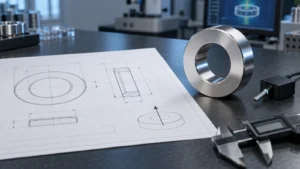
A clear drawing is strongly recommended. The drawing should show the magnetization direction using arrows or pole markings. This helps avoid confusion between axial and diametrical magnetization.
Example RFQ Description
A clear RFQ can be written as follows:
Product: Diametrically magnetized NdFeB disc magnet
Material: NdFeB
Grade: N35H or similar high-temperature grade
Size: Ø19.5 mm × 2.5 mm thick
Magnetization: Diametrically magnetized / magnetized through diameter
Coating: Ni-Cu-Ni
Application: Sensor / rotating magnetic component
Quantity: Please quote samples and production quantities
Important note:
Diametrical magnetization is critical. Please do not quote axial magnetization unless diametrical magnetization is not feasible.
Quality Inspection
For custom diametrically magnetized magnets, inspection may include:
- Dimensional inspection
- Visual surface inspection
- Coating inspection
- Magnetization direction confirmation
- Magnetic field measurement
- Pole identification
- Packaging verification
For sensor and encoder applications, magnetic field consistency may be more important than pull force. Therefore, customers should specify whether they require surface field data, flux measurement, or magnetic field mapping.
Common Design Mistakes
Mistake 1: Assuming All Disc Magnets Are the Same
Disc magnets can be magnetized in different directions. Axial and diametrical magnetization are not interchangeable.
Mistake 2: Only Specifying Size and Grade
Size and grade are not enough. Magnetization direction must be clearly stated.
Mistake 3: Ignoring Operating Temperature
NdFeB magnets may lose performance if the operating temperature exceeds the grade limit. High-temperature grades should be considered when necessary.
Mistake 4: Using the Wrong Coating
Ni-Cu-Ni is common, but it may not be suitable for every environment. Humidity, salt exposure, chemicals, and assembly conditions should be considered.
Mistake 5: Not Providing a Drawing
A drawing with magnetization direction reduces quotation errors and production risk.
FAQ
What is a diametrically magnetized disc magnet?
It is a round magnet with north and south poles located on opposite sides of the diameter instead of on the flat faces.
Is diametrical magnetization the same as radial magnetization?
For simple disc or cylinder magnets, the terms are sometimes used loosely, but “diametrically magnetized” is more precise. It means the magnet is magnetized through the diameter.
Can any disc magnet be diametrically magnetized?
Not always. Feasibility depends on magnet size, thickness, grade, and magnetizing fixture capability.
Why is diametrical magnetization important for sensors?
It creates a rotating magnetic field pattern that can be detected by Hall sensors, encoder chips, and other magnetic sensing devices.
Is N35H suitable for diametrically magnetized magnets?
N35H may be suitable depending on size, temperature, and magnetic field requirements. Feasibility should be checked before production.
Can Ni-Cu-Ni coating be used?
Yes, Ni-Cu-Ni is a common coating for NdFeB magnets. Other coatings may be recommended for harsh environments.
Can samples be supplied?
Sample availability depends on size, grade, magnetization direction, tooling, and stock availability.
What information is needed for quotation?
The most important information includes size, grade, coating, magnetization direction, quantity, tolerance, and application.
Conclusion
Diametrically magnetized NdFeB disc magnets are specialized magnetic components used in sensors, encoders, rotating assemblies, compact motors, magnetic couplings, and precision devices. Unlike standard axial disc magnets, they provide a magnetic field across the diameter, making them suitable for applications where side-facing or rotating magnetic fields are required.
When requesting a quote, the magnetization direction must be clearly specified. For custom designs such as Ø19.5 mm × 2.5 mm thick, N35H, diametrically magnetized, Ni-Cu-Ni coated NdFeB disc magnets, the supplier should confirm grade availability, magnetization feasibility, coating suitability, sample options, and production tolerances.
Magnetstek supports custom NdFeB magnets with different shapes, grades, coatings, and magnetization directions. Send us your drawing, required magnetization direction, working temperature, and quantity, and our team can help evaluate the most suitable magnet solution for your application.