

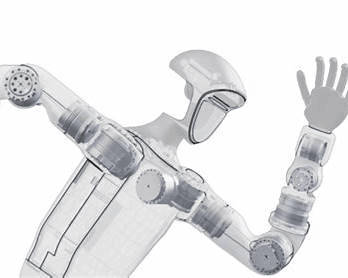
1. Robot Joint Motors: The Real Constraints Behind the Design
1.1 The Joint Is Not “Just a Motor”
In a robot, the joint is a highly integrated electromechanical module, typically combining:
A harmonic or planetary reducer
A position feedback system (encoder)
A braking or holding mechanism
Bearings, seals, and thermal paths
All of this must fit into a small, lightweight envelope while delivering high continuous torque, high peak torque, and precise, smooth motion.
Unlike conventional industrial motors, joint motors operate under:
- Severe space constraints (axial and radial)
- Frequent start–stop cycles
- High dynamic torque demands
- Long duty cycles with minimal maintenance
These realities strongly favor ring-shaped magnetic architectures over discrete block magnets.
2. Why Magnetic Rings Fit Robot Joint Motors Better Than Block Magnets
2.1 Geometric Compatibility With the Rotor
Most robot joint motors adopt outer-rotor or thin inner-rotor topologies to maximize torque density. In these designs:
- The rotor circumference is the primary magnetic working surface
- Continuous magnetic coverage is critical
A radially magnetized magnetic ring naturally conforms to this geometry, offering:
- 360° continuous magnetic flux
- No magnetic dead zones between blocks
- Uniform air-gap flux distribution
By contrast, segmented block magnets introduce:
- Assembly gaps
- Magnetic discontinuities
- Higher cogging torque and torque ripple
2.2 Improved Magnetic Circuit Efficiency
From a magnetic-circuit perspective, a ring magnet:
- Minimizes leakage flux
- Improves effective utilization of magnet volume
- Supports thinner back-iron designs
This allows designers to:
- Reduce motor size
- Lower weight
- Increase power density
In compact joint modules, these gains are not incremental—they are decisive.
3. Torque Density: The Primary Driver Behind High-Performance Rings
3.1 Why Torque Density Matters More Than Peak Power
For robot joints, torque density (Nm/kg or Nm/L) is far more important than peak power:
- Higher torque density → smaller joint size
- Smaller joints → lighter arms
- Lighter arms → lower energy consumption and better safety
Torque output in permanent-magnet motors is directly influenced by:
- Magnetic flux density in the air gap
- Magnetic field uniformity
- Effective pole count
High-performance NdFeB magnetic rings offer:
- High remanence (Br)
- High maximum energy product ((BH)max)
- Strong resistance to demagnetization
3.2 Multi-Pole Magnetic Rings Enable Compact High-Torque Designs
Modern joint motors increasingly rely on high pole-count designs:
- 8, 12, 16, 24 poles or more
- Short electrical periods
- Improved low-speed control
Multi-pole radially magnetized rings enable:
- Higher torque at lower rotational speeds
- Reduced reliance on extremely high gear ratios
- Improved backdrivability and force control
Without high-quality multi-pole magnetic rings, these architectures are not feasible.
4. Precision Motion: Magnetic Rings as a Control-Critical Component
4.1 Magnetic Rings Are Part of the Control System
In many joint designs, the magnetic ring is not only a torque-producing element but also:
- The magnetic reference for encoders
- A commutation signal source
- A position-feedback baseline
Any imperfection in the magnetic ring—such as pole pitch variation or local flux imbalance—directly translates into:
- Speed ripple
- Torque ripple
- Control noise
- Reduced positioning accuracy
4.2 Why Magnetic Uniformity Matters
High-performance magnetic rings are engineered to achieve:
- Tight pole-to-pole consistency
- Smooth magnetic field transitions
- Minimal harmonic distortion
This is critical for:
- Low-speed crawling motion
- Force-controlled manipulation
- Human-robot interaction scenarios
In humanoid robots, where motion smoothness affects perceived intelligence and safety, magnetic quality becomes a system-level concern.
5. High-Speed and High-Cycle Reliability Requirements
5.1 Mechanical Stresses in Robot Joint Rotors
Robot joint motors often operate at:
- Several thousand RPM on the motor side
- Continuous acceleration and deceleration
- Elevated internal temperatures
Under these conditions, magnetic rings must withstand:
- Significant centrifugal forces
- Thermal expansion mismatch
- Long-term fatigue
Poorly manufactured rings risk:
- Micro-cracking
- Partial delamination
- Sudden magnetic failure
5.2 What Makes a Magnetic Ring “High Performance”
A high-performance magnetic ring typically requires:
- High-density sintering
- Optimized grain orientation
- Controlled magnetization processes
- Reliable surface coatings (NiCuNi, epoxy, Parylene, etc.)
In some cases, additional mechanical reinforcement—such as sleeves or bonding systems—is applied to ensure safety at speed.
6. Thermal Stability and Demagnetization Resistance
6.1 Temperature Is the Silent Performance Killer
Joint motors generate heat from:
- Copper losses
- Iron losses
- Mechanical friction
Temperature rise affects magnets by:
- Reducing magnetic output
- Increasing demagnetization risk
High-performance magnetic rings are selected with:
- Appropriate intrinsic coercivity (Hcj)
- Safety margins for worst-case temperatures
This ensures stable torque output across the full operating envelope.
7. Integration Trend: Motor + Reducer + Encoder in One Module
7.1 Magnetic Rings Enable Functional Integration
The robotics industry is clearly moving toward integrated joint modules, where:
- The motor rotor magnet
- The encoder magnetic scale
- The mechanical reference
may coexist in a tightly coupled assembly.
Magnetic rings make this integration practical by:
- Offering consistent geometry
- Supporting multi-functional magnetization patterns
- Simplifying alignment during assembly
This reduces part count, assembly time, and cumulative tolerance errors.
8. Why “Standard” Magnetic Rings Are No Longer Enough
8.1 Customization Is Becoming the Norm
Robot OEMs increasingly specify:
- Custom pole counts
- Custom magnet grades
- Tight dimensional tolerances
- Defined magnetic field profiles
This transforms the magnetic ring from a catalog item into a custom magnetic component, requiring close collaboration between motor designers and magnet manufacturers.
9. Engineering Summary: Magnetic Rings as a Foundational Technology
The dependence of robot joint motors on high-performance magnetic rings is not a trend—it is a structural necessity driven by physics, integration, and system-level optimization.
High-performance magnetic rings enable:
- Higher torque density
- Better motion smoothness
- Improved control accuracy
- Greater reliability and lifetime
- Compact, integrated joint architectures
In next-generation humanoid and collaborative robots, the magnetic ring is no longer a passive part—it is a performance-defining element.
About Magnetstek
Magnetstek specializes in custom high-performance magnetic rings and magnetic assemblies for robotics, motors, medical devices, and precision automation. With strong capabilities in multi-pole radial magnetization, tight tolerance control, and application-driven engineering support, Magnetstek works closely with customers to turn magnetic design challenges into system-level advantages.